## Egypt, Hellenism, and the Birth of Al-Kimiya
Alchemy: The Great Work Beyond Gold
The Hidden DoctrineContent Disclaimer: This article contains speculative theories presented for entertainment. Readers are encouraged to form their own conclusions.
The word "alchemy" comes from the Arabic "al-kimiya," which in turn likely derives from the Greek "Khemia" or "Khemet," a name for Egypt meaning "the black land" (a reference to the dark Nile silt). This etymology is fitting because alchemy was born in Egypt, specifically in the Greek-speaking Egyptian city of Alexandria, where Hellenistic philosophy, Egyptian temple craft, Babylonian astrology, and Jewish mysticism all collided in one of history's most productive intellectual environments.
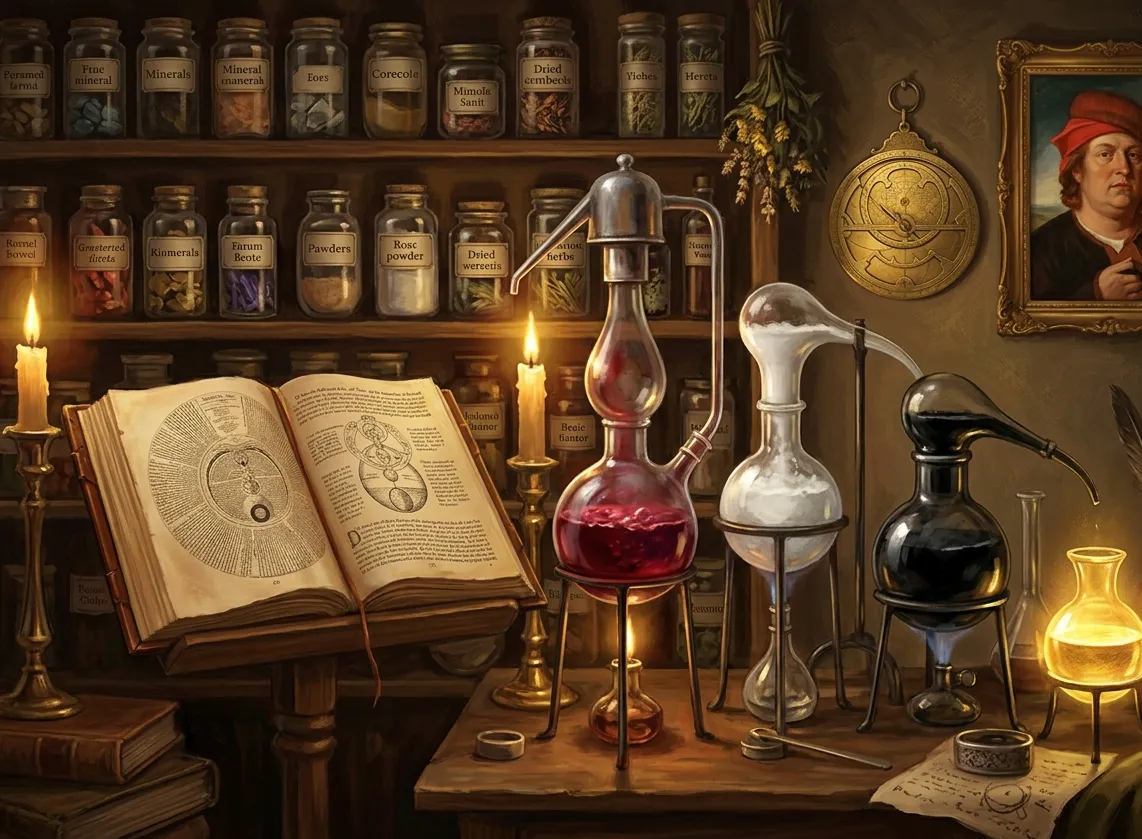
The earliest alchemical texts date to around the 1st to 3rd centuries CE and are attributed to mythological figures: Hermes Trismegistus (Thrice-Great Hermes), Zosimos of Panopolis, and the legendary Maria Prophetissa (Mary the Jewess), who is credited with inventing several pieces of laboratory apparatus still in use today, including the bain-marie (water bath) that still carries her name in French. These early alchemists were doing genuine chemistry, working with mercury, sulfur, lead, copper, gold, and complex distillation processes. But they were also doing something else: they were embedding their chemical procedures within a cosmological framework that made the laboratory a microcosm of the universe.
The central operating principle was "as above, so below," the Hermetic maxim from the Emerald Tablet (a text attributed to Hermes Trismegistus, probably composed in the early medieval period but claiming much greater antiquity). What happens in the flask mirrors what happens in the cosmos. The transformation of base metal into gold mirrors the transformation of the impure soul into its divine original state.
## The Magnum Opus: Four Stages of a Journey
The Great Work (Magnum Opus) in alchemical tradition is the process of creating the Philosopher's Stone, a substance that could transmute base metals into gold and, more importantly, extend human life indefinitely. But the descriptions of the process make it clear that this was never only about physical transformation.
The Great Work proceeds through four stages, each associated with a color.
Nigredo (blackening) is the first and most brutal stage. The initial material must be broken down completely. In the flask, this might involve calcination (burning to ash) or putrefaction. In the practitioner, nigredo is the confrontation with darkness, failure, worthlessness, and death. The alchemists described it as the death of the old form, necessary before any new form could emerge. They called it the massa confusa, the confused mass, the undifferentiated chaos that contains all possibilities precisely because it has lost all specificity.
Albedo (whitening) follows: the first light returns. In the flask, the blackened matter begins to lighten, to purify, to reveal an inner structure. In the practitioner, albedo is the emergence from darkness into a kind of clarity, purified by the ordeal of nigredo but not yet complete. The alchemical texts describe visions of the moon, of silver light, of feminine principles.
Citrinitas (yellowing) was the third stage in some traditions, representing a further warming and brightening, the approach toward the solar. Some later alchemists collapsed citrinitas into rubedo.
Rubedo (reddening) is the culmination: the full manifestation of the red Stone, the completed work, the integration of all the preceding stages into a unified whole that is more than the sum of its parts. Gold is red before it is fully refined. The alchemists called this the Philosopher's Stone, the Red King, the conjunction of opposites finally resolved.
## Nicolas Flamel, Newton, and the Practitioners
Nicolas Flamel, a 14th century Parisian scrivener, became the most famous alchemist in European popular imagination, though the elaborate legend attached to his name (purchasing an ancient alchemical manuscript, traveling to Spain to decode it with a Jewish sage, achieving the transmutation of mercury into gold in 1382) was largely constructed by later writers. The real Flamel was a prosperous notary and philanthropist, but not verifiably an alchemist. What's interesting is that the legend kept growing for centuries and still persists, which says something about the alchemical imagination itself: it cannot resist the story of the ordinary person who breaks through to the extraordinary.
Paracelsus (Theophrastus Bombastus von Hohenheim, 1493-1541) was something more verifiable and considerably more disruptive. He was the first figure to systematically apply alchemical principles to medicine, arguing that the purpose of alchemy was not to make gold but to make medicines. His concepts of dose-dependent toxicity ("the dose makes the poison"), the role of specific chemical agents in specific diseases, and the importance of direct observation over received authority were revolutionary and directly ancestral to modern pharmacology.
Isaac Newton is the surprise in the alchemical genealogy. Newton spent years, by some estimates more years than he spent on the physics and mathematics that made him famous, working on alchemical texts and experiments. His notebooks reveal a systematic engagement with alchemical literature and hands-on laboratory work involving mercury, sulfur, and various metals. Newton's alchemy wasn't a youthful indiscretion or a private embarrassment. It was central to his intellectual project. He believed that the universe was animated by active principles that operated through matter, and alchemy was his attempt to identify and work with those principles directly. The mechanistic physics of the Principia was, for Newton, only half the picture. The other half was alive, responsive, and best approached through the alchemical tradition.
Related Articles