Carl Jung's Journey
Collective Unconscious: Jung's Theory of the Collective Mind
The Hidden DoctrineContent Disclaimer: This article contains speculative theories presented for entertainment. Readers are encouraged to form their own conclusions.
Carl Gustav Jung began his career as a devoted follower of Sigmund Freud. The two men corresponded extensively and Freud initially saw Jung as his intellectual heir, the man who would carry psychoanalysis forward.
But Jung's clinical observations led him toward ideas that would eventually create an irreparable rift. He noticed patterns in his patients' dreams and fantasies that seemed to transcend personal experience.
> What Jung discovered in the depths of the psyche would fundamentally challenge assumptions about the nature of human consciousness and the boundaries of individual identity.
Images appeared in dreams that patients could not have learned through personal experience. Symbols emerged that matched ancient mythological motifs unknown to the dreamers. Something more than personal memory seemed at work.
Jung and Freud disagreed fundamentally about the nature of the unconscious mind. For Freud, the unconscious contained repressed personal material, primarily sexual in nature. Jung saw something far more vast.
Their correspondence reveals the growing tension. Jung's insistence on a collective layer of the unconscious struck Freud as mystical nonsense. Freud's reduction of all symbolism to sexual meaning struck Jung as reductive.
> The split between these two giants of psychology created separate traditions that continue to influence therapeutic practice today.
By 1913, the break was complete. Jung entered a period of intense self-exploration that he later called his "confrontation with the unconscious." This personal crisis would yield his most influential ideas.
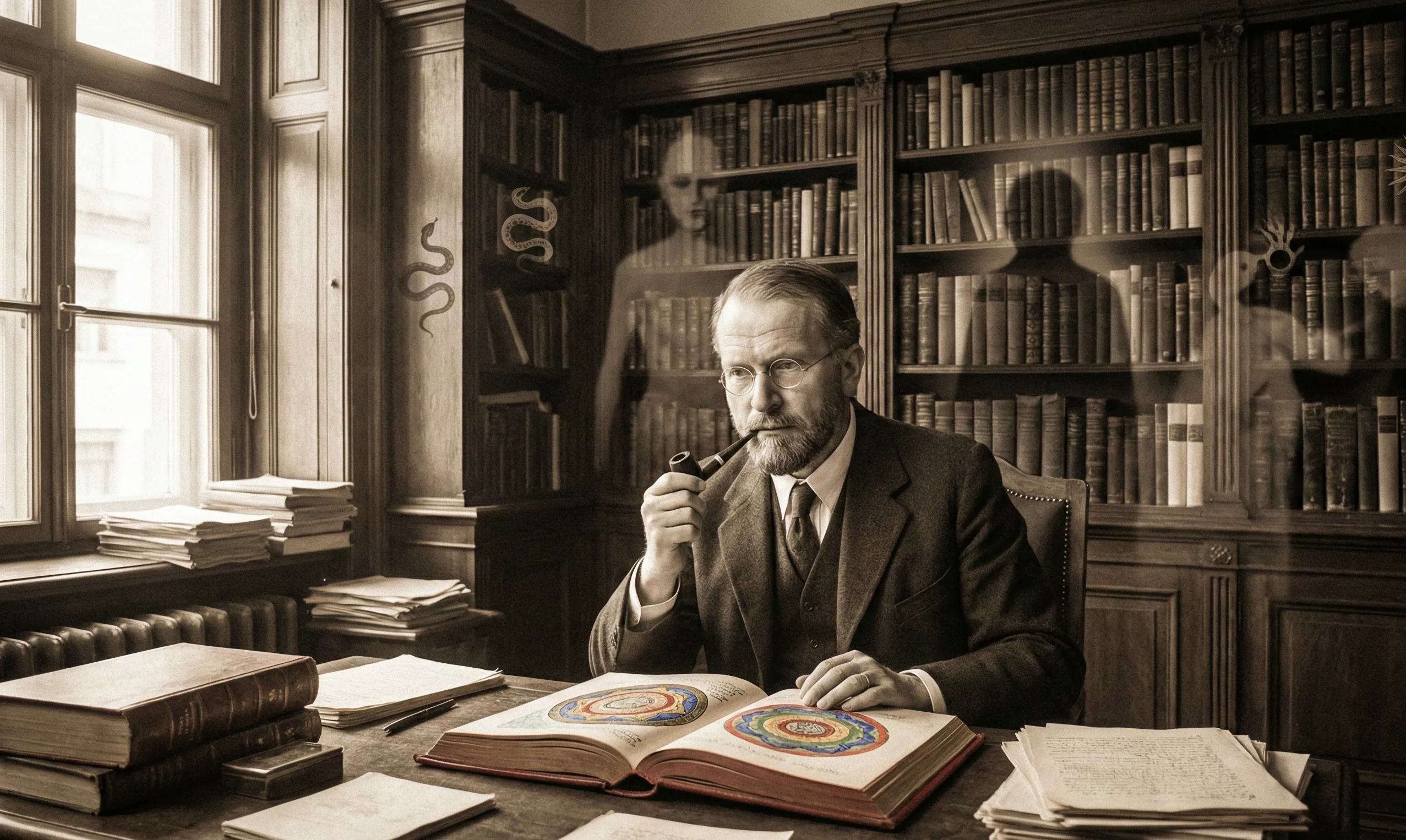
During his psychological crisis, Jung recorded his visions, dreams, and inner dialogues in what became known as "The Red Book." This extraordinary document remained unpublished until 2009.
The imagery that emerged during this period convinced Jung that he was accessing something beyond personal psychology. Figures appeared that seemed to embody universal human patterns.
> The Red Book reveals a mind grappling with experiences that exceeded the categories available to explain them.
Jung spoke with figures he called Philemon, Salome, and others. These encounters felt autonomous, as if the figures existed independently of his conscious will. They provided insights he felt he could not have generated himself.
From his clinical observations and personal experiences, Jung developed the concept of the collective unconscious. He proposed that beneath our personal unconscious lies a deeper layer shared by all humanity.
This collective layer contains not memories or experiences but potentials for experience that Jung called archetypes. These are patterns that shape how we perceive and respond to fundamental life situations.
> The collective unconscious is not a place but a dimension of psyche, a shared heritage of psychological patterns inherited like physical characteristics.
Archetypes include the Mother, the Father, the Hero, the Shadow, the Anima and Animus, and many others. They manifest differently across cultures but share underlying structural similarities.
Jung found support for his theory in comparative mythology. Scholars had documented striking parallels between myths from cultures with no historical contact.
The hero's journey appears in stories from every continent. Creation myths share structural elements. Flood narratives occur in traditions separated by oceans. Death and rebirth symbolism pervades religious imagery worldwide.
> If minds were purely individual, these universal patterns would require explanation through cultural diffusion. The collective unconscious offered an alternative: shared psychological inheritance.
Joseph Campbell would later popularize these cross-cultural mythological patterns in works like "The Hero with a Thousand Faces." His work brought Jungian ideas to broader audiences.
Jung identified numerous archetypes through his clinical work and study of world mythology. Each represents a fundamental aspect of human experience.
The Shadow contains all we reject about ourselves, the dark brother or sister that mirrors our conscious identity. The Anima and Animus represent contrasexual elements within the psyche. The Self symbolizes psychological wholeness and integration.
> Understanding archetypes provides a map for navigating the inner world, recognizing the forces that shape our perceptions and behaviors.
These are not fixed images but dynamic patterns. The specific form an archetype takes depends on culture and individual psychology. But the underlying pattern remains constant across human experience.
Jung's exploration of the collective unconscious led him to the concept of synchronicity. He observed meaningful coincidences that seemed to defy causal explanation.
Working with physicist Wolfgang Pauli, Jung proposed that psyche and matter might be connected at levels deeper than ordinary causation allows. Meaningful patterns might manifest simultaneously in inner and outer worlds.
> Synchronicity suggested that the collective unconscious extends beyond individual minds to connect with physical reality itself.
This remains Jung's most controversial idea. Critics see it as unfalsifiable mysticism. Supporters argue it points toward aspects of reality that materialist science cannot accommodate.
Jung developed empirical methods for exploring the unconscious. His word association test revealed clusters of emotionally charged material that he called complexes.
Subjects responded to stimulus words while Jung measured response time and physiological indicators. Delays and unusual responses revealed unconscious material that consciousness tried to avoid.
> This experimental approach demonstrated that Jung sought empirical foundations for his theories, not mere speculation.
The test revealed that complexes could operate autonomously, affecting behavior without conscious awareness. This supported the idea that the psyche contains regions beyond personal control.
Jung's ideas influenced scholars across disciplines. Mircea Eliade studied religious symbolism through a Jungian lens. Joseph Campbell brought mythological analysis to popular audiences.
Religious studies adopted archetypal frameworks for understanding the persistence and power of sacred imagery. Anthropologists examined how universal patterns manifested in diverse cultural contexts.
> The collective unconscious provided a framework for understanding both the diversity and unity of human symbolic life.
Critics argued that this approach flattened cultural differences, reducing distinct traditions to variations on universal themes. Supporters countered that recognizing shared humanity did not diminish cultural uniqueness.
Jung founded a distinct school of psychotherapy he called analytical psychology. This approach focuses on integrating unconscious content into conscious awareness through dream work, active imagination, and symbol analysis.
The goal of Jungian therapy is individuation, the process of becoming more fully oneself by integrating previously unconscious material. This involves dialogue with archetypal forces and integration of the shadow.
> Healing in the Jungian framework means becoming whole, accepting all aspects of one's nature rather than repressing the unacceptable.
Training institutes worldwide continue teaching Jungian methods. The approach has evolved but maintains its focus on depth, symbolism, and the search for meaning.
Related Articles