The Oldest Dream: Rewriting What Is Alive
CRISPR: Rewriting the Code of Life
Arcane SciencesContent Disclaimer: This article contains speculative theories presented for entertainment. Readers are encouraged to form their own conclusions.
Long before anyone knew what a gene was, humans were already editing life. They did not call it that. They called it breeding. Selection. Improvement. But the ambition was the same. Take what nature made. Make it something else.
Ten thousand years ago, in the river valleys of Mesopotamia, farmers began choosing which seeds to plant and which animals to breed. Within a few generations, wolves became dogs. Wild grasses became wheat. It was slow, blind, and brutally effective. No one understood why it worked. They only knew that it did.
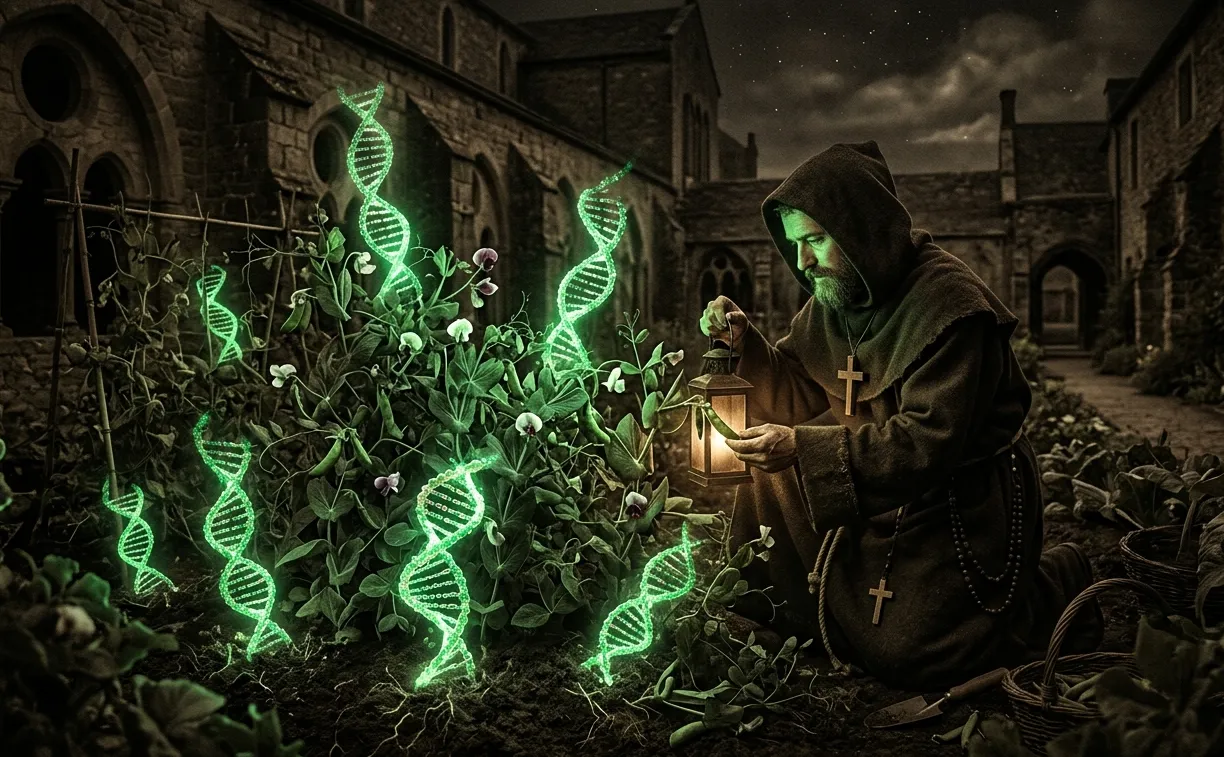
Then came Gregor Mendel. A monk in a garden. Brno, 1856. He counted peas. He tracked colors, shapes, heights. He found patterns no one had seen before. Traits followed rules. They could be predicted. They could be controlled. Mendel published his findings in 1866. Almost no one read them.
For thirty-four years, his work gathered dust. When it was rediscovered in 1900, the world changed. Not slowly. Not gently. The science of heredity was born, and within a decade, it had a name: genetics. Within two decades, it had a dark twin: eugenics.
Francis Galton, Charles Darwin's cousin, had already been pushing the idea that human populations could be improved through selective breeding. Mendel's laws gave him the scientific cover he needed. By the early 1900s, eugenics programs were running in the United States, Britain, Scandinavia, and dozens of other countries. Forced sterilizations. Marriage restrictions. Immigration controls based on "genetic fitness." The State of Indiana passed the world's first compulsory sterilization law in 1907. California followed. By the 1930s, over 60,000 Americans had been sterilized against their will.
Nazi Germany took notes. Literally. American eugenics research was cited in German racial hygiene programs. The Holocaust did not emerge from nowhere. It grew from a seed planted in laboratories and legislatures that believed they had the right to decide who should exist.
After World War II, eugenics became a dirty word. But the desire to control heredity did not disappear. It went underground. It changed clothes. It became molecular biology.
In 1953, James Watson and Francis Crick announced the structure of DNA. The double helix. The blueprint of life, finally visible. What Mendel had tracked through pea flowers, Watson and Crick could now see at the atomic level. The code was real. It was written in four letters: A, T, G, C.
The race to read it, and then rewrite it, began immediately.
By the 1970s, scientists had learned to cut DNA with restriction enzymes. They could splice genes from one organism into another. Recombinant DNA technology was born. In 1973, Herbert Boyer and Stanley Cohen created the first genetically modified organism. A bacterium carrying a gene from a frog. It was crude. It was revolutionary.
The scientific community panicked. In 1975, the Asilomar Conference brought together 140 biologists to discuss the dangers of what they had created. They drafted voluntary guidelines. They agreed to proceed with caution. It was the last time the field would pause to ask whether it should.
Through the 1980s and 1990s, genetic engineering accelerated. Insulin-producing bacteria. Herbicide-resistant crops. Glow-in-the-dark mice. Each breakthrough pushed the boundary further. Each one normalized the idea that life could be edited like text on a screen.
But the tools were clumsy. Restriction enzymes cut DNA at fixed sequences. You could not choose your target with precision. Inserting a gene was like trying to edit a novel by tearing out pages and gluing in new ones. It worked, sometimes. It was never elegant.
Then, in the early 2000s, a handful of researchers noticed something strange in bacterial genomes. Repeating sequences of DNA, separated by unique spacer sequences. They looked like a filing system. A biological archive. Bacteria were storing fragments of viral DNA, keeping records of past infections. And they were using those records to fight back.
The system had a name: Clustered Regularly Interspaced Short Palindromic Repeats. CRISPR.
In 2012, Jennifer Doudna and Emmanuelle Charpentier published a paper that changed everything. They showed that the CRISPR system could be reprogrammed. You could design a guide RNA to target any sequence of DNA you wanted. The Cas9 protein would cut it. Precisely. Cleanly. Anywhere in any genome.
For the first time in history, editing a gene became as simple as finding a word in a document and pressing delete. Or replacing it with something new.
The oldest dream of controlling life had finally found its perfect instrument. The question no one wanted to ask was simple. Who gets to use it? And on whom?
Related Articles