## The Best-Kept Secret in Western History
The Eleusinian Mysteries: What Happened Inside the Temple
The Hidden DoctrineContent Disclaimer: This article contains speculative theories presented for entertainment. Readers are encouraged to form their own conclusions.
Consider what we know and what we don't.
We know that the Eleusinian Mysteries ran for approximately 1,500 to 2,000 years, from sometime before 600 BCE until the Roman Emperor Theodosius ordered the closure of pagan temples in 392 CE. We know that participation was open to any Greek speaker who had not committed murder and could afford the initiation fees. We know that hundreds of thousands of people were initiated over the centuries, including Plato, Aristotle, Sophocles, Aeschylus, Cicero, Marcus Aurelius, and the Emperor Hadrian. We know that initiates were legally forbidden, on pain of death, from revealing what occurred during the inner rites.
And here is the remarkable thing: nobody broke the oath. For two thousand years, across all the social upheavals and political changes of the ancient Mediterranean world, the secret held. We have fragments of description from writers who were not initiated, and a few pieces from initiates who spoke in general terms. But the core of what happened inside the Telesterion, the great initiation hall at Eleusis, remains unknown.
This is extraordinary. Humans are terrible at keeping secrets. The fact that this one held, across so many generations and so many thousands of participants, suggests that whatever the initiates experienced was powerful enough to make the prohibition feel not like a legal threat but like an internal imperative. You simply couldn't speak of it, not because you feared punishment, but because language was inadequate.
## Demeter, Persephone, and the Myth That Was the Frame
The Mysteries were built around a myth. Persephone, daughter of the grain goddess Demeter, is abducted by Hades and taken to the underworld. Demeter's grief is so total that she abandons her role, and the earth becomes barren. Nothing grows. Humanity faces extinction. Eventually Zeus intervenes, Persephone is returned (though she must spend part of each year below, accounting for winter), and Demeter, out of gratitude to Eleusis where she rested in her wandering, teaches the town's residents the Mysteries.
On its surface, this is an agricultural myth explaining the seasons. But the ancient Greeks were sophisticated enough to read myths on multiple levels simultaneously, and the initiates knew they were enacting something that went beyond weather patterns.
The journey to the underworld and back is one of the oldest mythological structures in human storytelling. It appears in Inanna's descent in Sumerian mythology, in Orpheus's attempt to retrieve Eurydice, in Gilgamesh's quest, in the later Christian resurrection narrative. The structure is consistent: descent, death or apparent death, transformation, return. The initiate doesn't just watch this story. At Eleusis, they appear to have lived it in some experiential sense.
## Nine Days of Preparation and the Sacred Road
The Greater Mysteries took place in late September, following the autumn grain harvest. They lasted nine days, a number tied to Demeter's nine-day search for Persephone.
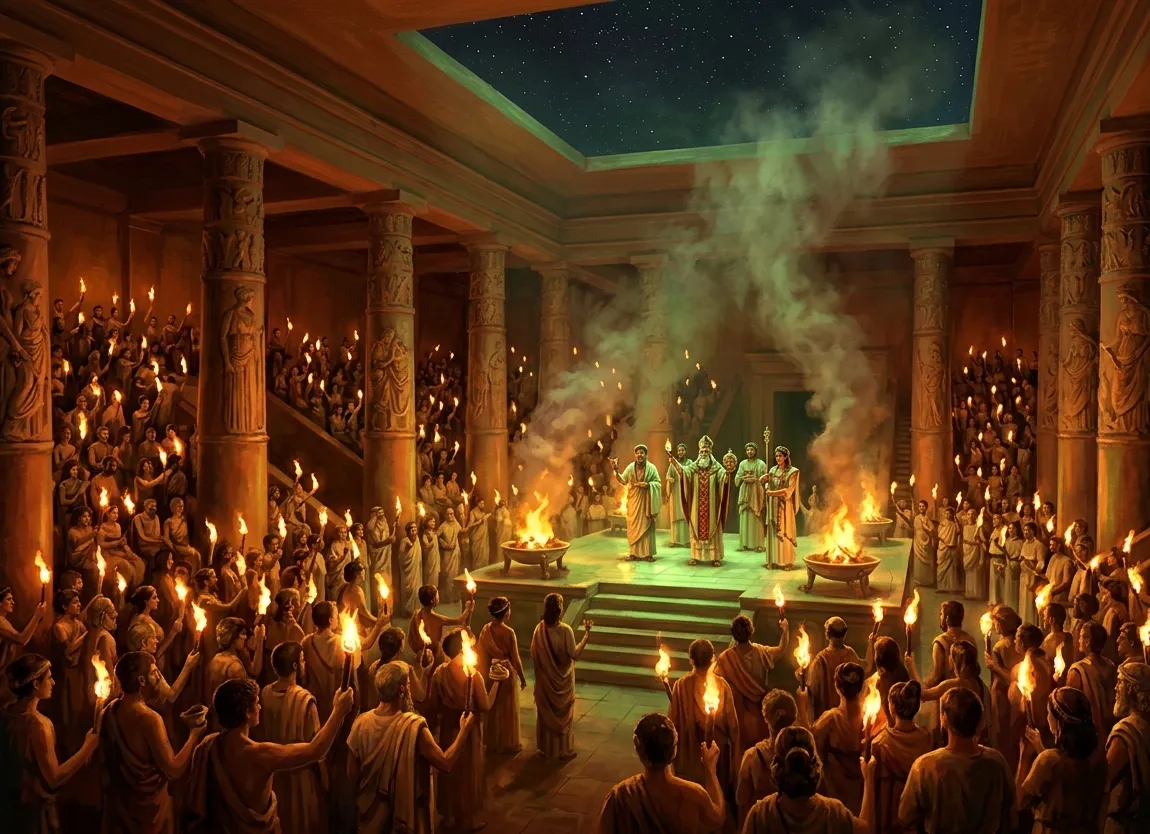
The first days involved purification. Initiates bathed in the sea, sacrificed piglets (purification animals in Greek ritual), and observed abstinences. Then came the procession: eighteen miles from Athens to Eleusis along the Sacred Road, in daylight that faded into night, carrying torches, chanting, pausing at specific points to perform specific rituals, crossing the bridge over the Kephisos river where masked figures delivered ritual insults (another piece of the puzzle: ritual abasement before elevation).
They arrived at Eleusis after dark, exhausted, having fasted, having processed for hours. The sanctuary itself was old, with roots going back to Mycenaean Greece. The main hall, the Telesterion, could hold several thousand people simultaneously.
Here is where everything becomes uncertain. We know that three things occurred: things done (dromena), things shown (deiknumena), and things said (legomena). We know the initiates drank kykeon, a ritual beverage of barley, water, and pennyroyal mint. We know that after the experience, initiates reported no longer fearing death. Cicero wrote that Eleusis had given him "not only reasons to live with joy but also to die with better hope." Plato's description of the Forms, the transcendent realities behind material appearances, uses language that several scholars have noted sounds like a description of mystical experience.
## Plato, Socrates, and the Philosophers in the Mystery Line
This is the part that should stop you for a moment.
Plato, the founder of Western philosophy, almost certainly participated in the Eleusinian Mysteries. The timing works: he was Athenian, the Mysteries were accessible to Athenians, and the philosophical concerns at the heart of his work (the immortality of the soul, the distinction between appearance and reality, the journey of the mind toward truth) map directly onto what initiates reported experiencing.
When Plato in the Phaedo has Socrates describe death as a release into a fuller reality, when the Allegory of the Cave describes people who have seen only shadows mistaking them for the real, when the Symposium culminates in a vision of absolute Beauty itself, these are not arbitrary philosophical conceits. They read like attempts to describe in philosophical language something that was originally experienced directly.
Socrates himself, in Plato's account, speaks of philosophical inquiry as a kind of preparation for death, a practice of separating the soul from bodily concerns so that when the final separation comes, it can be received rather than feared. This is structurally identical to what the Mysteries were reported to accomplish. Whether Socrates was initiated or not, the project was the same.
The ancient world understood what modernity sometimes forgets: that philosophy and mystical practice were not opposed but complementary. The philosopher prepared the mind for direct experience. The Mystery provided the experience. Together, they changed a person permanently.
One of the few fragments we have from an initiate, preserved in the Christian writer Themistius, says simply: "The soul at the moment of death has the same experience as those who are initiated into the great Mysteries." Whatever happened inside the Telesterion, it seemed to give people a preview of something they could otherwise only encounter once.
Related Articles