## The Merkabah and the Chariot Riders
The Kabbalah: Blueprint of Creation
The Hidden DoctrineContent Disclaimer: This article contains speculative theories presented for entertainment. Readers are encouraged to form their own conclusions.
Something strange was happening in Jewish mysticism around the 1st century CE. While the rabbis were codifying law, debating scripture, and building the intellectual infrastructure of post-Temple Judaism, a quieter group was doing something else entirely. They were trying to ascend.
These were the Merkabah mystics, named after the divine chariot described in the opening chapter of Ezekiel. You know the vision: four creatures, four wheels within wheels, a crystalline expanse overhead, and above all of it, a throne of sapphire. Ezekiel himself seemed shaken by what he saw. The Merkabah mystics decided they wanted to see it too, and they developed elaborate techniques for doing so.
The practice involved fasting, ritual immersion, recitation of divine names, and what can only be described as a controlled journey through celestial palaces called Hekhalot. Seven heavens, seven halls, seven gatekeepers. Each one requiring the right password, the right seal, the right knowledge. Get it wrong and the journey ends badly. Get it right and you stand before the divine throne itself.
This wasn't casual religion. This was a technology for consciousness, dressed in the language of vision. And it was deliberately secret. The Talmud specifically warns against teaching these matters publicly. Certain knowledge was considered too dangerous for general distribution.
## Spain, Provence, and the Emergence of the Zohar
Fast forward to 12th and 13th century Provence and northern Spain. Jewish scholarship was at a peculiar peak. The Andalusian convivencia had produced centuries of cross-pollination between Jewish, Christian, and Islamic philosophy. Neoplatonism, Aristotelian metaphysics, and Sufi mysticism had all filtered through. The intellectual soil was rich.
Into this environment came the first systematic Kabbalistic texts. The Sefer Yetzirah (Book of Formation) was already ancient by this point, but it received new commentary. The Sefer Bahir appeared in Provence around 1175, introducing ideas about divine attributes and the structure of the Godhead that would become central to all later Kabbalah.
Then came the Zohar. In the 1280s, Moses de Leon began circulating a text he claimed to have discovered: the mystical teachings of Rabbi Shimon bar Yochai, a 2nd century sage who had supposedly hidden in a cave for thirteen years and emerged with cosmic knowledge. The Zohar was written in a deliberately archaic Aramaic, constructed to feel ancient. Most modern scholars believe Moses de Leon composed it himself, though the argument has never been fully settled.
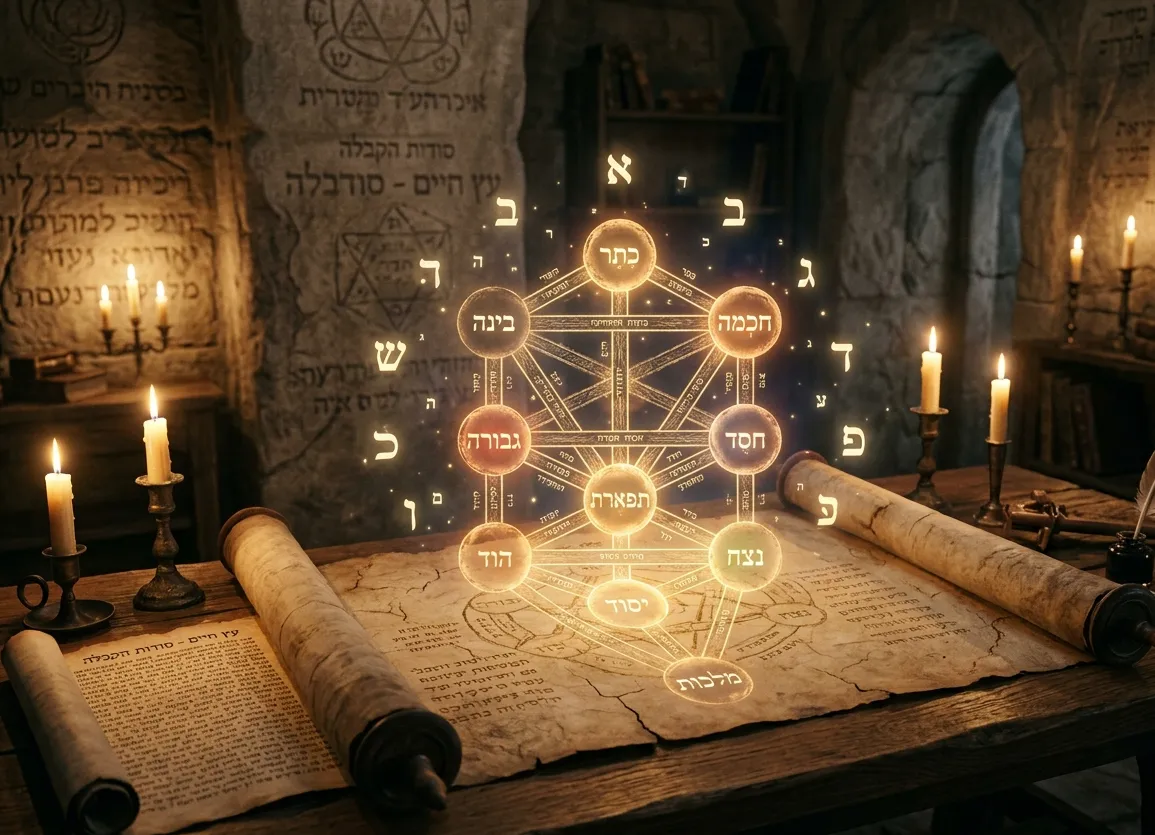
Regardless of its authorship, the Zohar became the foundational text of Kabbalah. Dense, poetic, sometimes impenetrable, it mapped the hidden structure of divinity using a system of ten attributes called the Sephiroth, arranged on a diagram that came to be called the Tree of Life.
## The Tree of Life: A Map of Everything
The Sephiroth aren't gods exactly. They're more like emanations, aspects, or qualities through which the infinite (Ein Sof, literally "without end") expresses itself in finite reality. The idea is that the pure, unknowable divine source cannot create directly. Creation happens through a cascading series of emanations, each one a step further from the infinite and closer to the material world we inhabit.
Picture it this way: Ein Sof is so utterly transcendent that even calling it "God" is anthropomorphizing it too much. It simply is, beyond description, beyond limitation, beyond even the concept of existence as we understand it. But somehow, from that absolute beyond, reality emerges. The Kabbalists wanted to understand how.
The Tree of Life is their answer. Ten Sephiroth arranged across three pillars: severity on the left, mercy on the right, balance in the middle. At the top, Kether (Crown), the first flash of existence from nothingness. At the bottom, Malkuth (Kingdom), the material world itself. Between them, eight more nodes representing qualities like wisdom, understanding, beauty, strength, and foundation.
The lightning bolt runs from top to bottom, the path of creation. The mystic's path runs the other way, from bottom to top, back toward the source.
## Isaac Luria and the Shattered World
The system received its most dramatic reworking in 16th century Safed, a small city in what is now northern Israel. Here, a community of extraordinary mystics gathered, including Joseph Karo (who also wrote the definitive code of Jewish law) and the man who would transform Kabbalah forever: Isaac Luria, known simply as the Ari, the Lion.
Luria didn't write much himself. His student Chaim Vital compiled his teachings, and they were revolutionary. Luria introduced three concepts that changed everything.
First, Tzimtzum: the idea that creation required God to contract, to withdraw, to make space for something other than God to exist. This single move reframed the entire relationship between Creator and creation. God didn't expand to create the universe. God pulled back.
Second, Shevirat HaKelim: the shattering of the vessels. In the initial rush of divine light following the Tzimtzum, the Sephirotic vessels couldn't contain the energy and shattered. Divine sparks scattered throughout creation, trapped in shells of spiritual impurity called Kelipot. This is why the world is broken. The brokenness isn't incidental. It's structural.
Third, Tikkun Olam: the repair of the world. Every moral act, every fulfilled commandment, every moment of genuine human connection lifts one of those scattered sparks back toward its source. Human beings aren't spectators in the cosmic drama. They're the repair mechanism.
This gave ordinary life extraordinary weight. The beggar you helped on the street might contain a divine spark. The ethical choice you made in a moment of private temptation might have cosmic consequences. The universe needs you to do the right thing. Its repair depends on it.
Luria died at 38. But his ideas spread across the Jewish world and eventually far beyond it, reaching audiences he never could have imagined.
Related Articles