Content Disclaimer: This article contains speculative theories presented for entertainment. Readers are encouraged to form their own conclusions.
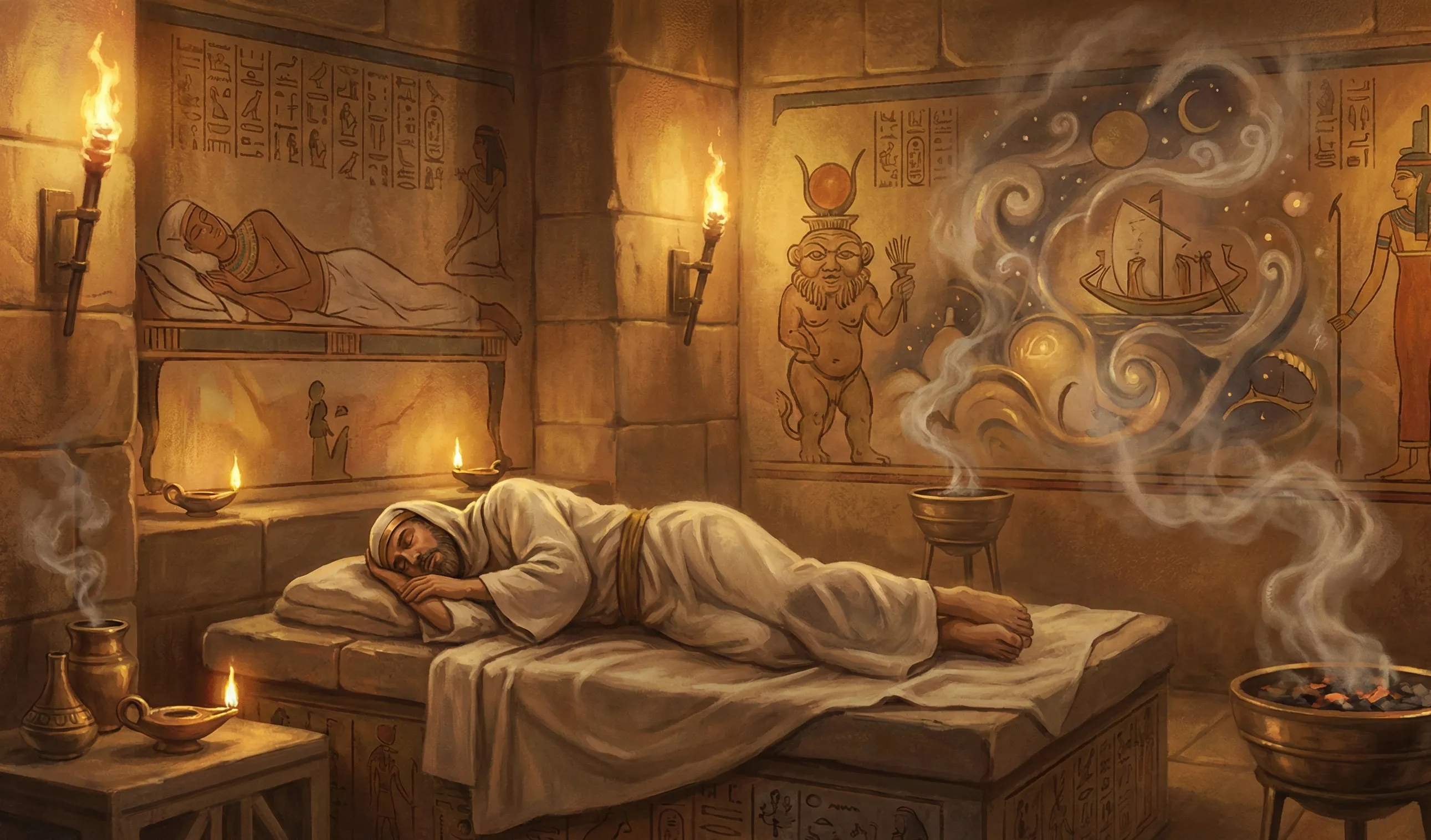
Throughout human history, dreams have been regarded as windows to realms beyond ordinary perception. Ancient civilizations believed dreams provided access to divine knowledge, including visions of events yet to unfold.
Egyptian pharaohs employed dream interpreters as essential advisors. The biblical story of Joseph rising to power through his ability to interpret Pharaoh's prophetic dreams reflects the importance placed on nocturnal visions.
> In the ancient world, the boundary between sleeping visions and waking reality was far more permeable than modern sensibilities allow.
Mesopotamian tablets from over four thousand years ago contain detailed dream interpretation guides. These texts reveal sophisticated systems for decoding symbolic imagery and predicting future events.
The Greeks formalized dream interpretation through the practice of incubation. Seekers would sleep in sacred temples, hoping to receive prophetic visions from the gods.
Aristotle took a more naturalistic approach. While skeptical of divine origins, he acknowledged that dreams sometimes seemed to anticipate future events. He proposed that dreamers might unconsciously perceive subtle signals missed by waking consciousness.
> The debate between supernatural and natural explanations for precognitive dreams began in classical antiquity and continues today.
Roman emperors relied on dream omens for military and political decisions. Calpurnia's dream warning Caesar of his assassination became one of history's most famous precognitive visions, though tragically ignored.
The medieval period saw dreams interpreted through religious frameworks. Saints and mystics reported prophetic visions during sleep, experiences the Church carefully scrutinized for signs of divine or demonic origin.
Hildegard of Bingen documented her visionary experiences extensively. Her prophetic dreams included detailed descriptions of future events that contemporaries verified as accurate.
> The line between dream and mystical vision blurred in medieval spirituality, both serving as channels for transcendent knowledge.
Common people also reported prophetic dreams. Village records contain accounts of individuals who foresaw deaths, disasters, and significant community events during sleep.
As rational inquiry displaced supernatural explanation, dreams lost their status as valid sources of knowledge. Enlightenment thinkers dismissed precognition as superstition incompatible with a clockwork universe.
Yet the experiences persisted. Individuals continued reporting dreams that seemed to anticipate events they could not have known through ordinary means.
> The triumph of scientific materialism did not eliminate precognitive experiences but merely removed the frameworks for understanding them.
Some scientists remained quietly interested. Swedenborg, himself a respected scientist, documented elaborate prophetic dreams that he believed revealed genuine glimpses of future events.
One of history's most famous precognitive dreams occurred in the weeks before Abraham Lincoln's assassination. The President described this dream to close associates, including Ward Hill Lamon who recorded the account.
Lincoln dreamed of wandering through the White House and encountering sounds of mourning. He discovered a corpse in the East Room, surrounded by soldiers and mourners. When he asked who had died, a soldier replied that the President had been killed by an assassin.
> Lincoln's dream, documented before his death, became an iconic example of apparent precognition by a historical figure whose credibility could not be questioned.
The President reportedly viewed the dream as an omen but proceeded without altering his plans. Weeks later, he was shot at Ford's Theatre by John Wilkes Booth.
Founded in 1882, the Society for Psychical Research brought academic methodology to investigating unusual mental phenomena. Precognitive dreams became a subject of systematic study.
Members collected hundreds of accounts from credible witnesses. They developed protocols for documenting dreams before the anticipated events occurred, addressing the obvious problem of after-the-fact rationalization.
> For the first time, precognitive experiences were subjected to careful academic scrutiny rather than simple acceptance or dismissal.
The research revealed challenges. Human memory proved unreliable. Dreams were often vague enough to match various outcomes. Yet some cases resisted debunking efforts.
J.W. Dunne, a British aeronautical engineer, conducted pioneering self-experiments on precognitive dreams. His 1927 book "An Experiment with Time" proposed that consciousness moved freely through time during sleep.
Dunne kept meticulous dream journals, recording dreams immediately upon waking. He then tracked how often these dreams matched future events compared to past events.
> Dunne's work suggested that dreams contained as many images from the future as from the past, challenging conventional assumptions about temporal consciousness.
His methodology had limitations critics readily identified. Yet his systematic approach influenced generations of subsequent researchers.
J.B. Rhine's parapsychology laboratory at Duke University investigated precognition through controlled experiments. While most work focused on waking ESP, researchers also studied dream precognition.
Studies attempted to document dreams that predicted randomly determined future targets. Results were mixed but occasionally showed statistical anomalies that defied chance explanation.
> Laboratory research brought scientific rigor to a field previously dependent on anecdotal accounts.
On October 21, 1966, a colliery waste tip collapsed in the Welsh village of Aberfan, killing 144 people including 116 children. The tragedy became a focal point for precognitive dream research.
Psychiatrist John Barker collected accounts from individuals who claimed to have dreamed of the disaster before it occurred. He received over 200 responses, many with details documented before the event.
> The Aberfan case suggested that major tragedies might generate precognitive impressions across many individuals, as if the future cast shadows backward in time.
One particularly striking case involved a young victim who told her mother of dreaming about something black covering her school. She died in the disaster two days later.
The Maimonides Medical Center in Brooklyn conducted the most rigorous dream ESP research of the twentieth century. From 1964 to 1978, researchers studied whether sleeping subjects could receive telepathic or precognitive information.
Subjects slept in the laboratory while monitored for REM sleep. Upon awakening, they described their dreams, which were then compared to target images selected after the dream.
> The Maimonides experiments produced statistically significant results that skeptics struggled to explain while proponents struggled to replicate.
The laboratory eventually closed, but its protocols and findings continue to influence consciousness research.
Related Articles