
Content Disclaimer: This article contains speculative theories presented for entertainment. Readers are encouraged to form their own conclusions.
The Cold War was fought on many fronts. In the silos of nuclear missiles. In the shadow conflicts of proxy wars. In the race to the Moon. But there was another front, one so bizarre that for decades, historians refused to believe it existed. It was the war for the human mind.
In 1970, American intelligence agencies received a disturbing report. The Soviet Union was spending 60 million rubles a year on "psychotronics"—the study of psychic phenomena for military use. The report claimed the KGB was successfully training agents to read documents inside locked safes in Washington, D.C., from rooms in Moscow.
Panic set in. If the Soviets could view top-secret files with their minds, no encryption in the world could protect the United States. The CIA had to close the "Psi Gap."
Thus began one of the strangest chapters in military history: Project Stargate.
The project was not run by mystics or gurus, but by physicists. In 1972, the CIA contracted the Stanford Research Institute (SRI) in Menlo Park, California. The program was headed by Dr. Hal Puthoff and Russell Targ, two laser physicists who were tasked with applying the scientific method to the impossible.
Their star subject was Ingo Swann, a New York artist who claimed he could detach his consciousness from his body and travel to any coordinate on the planet. This ability was coined "Remote Viewing."
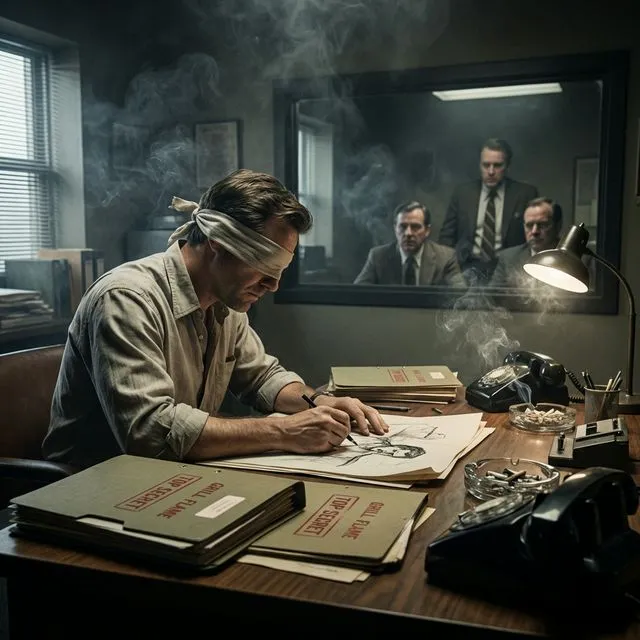
The early tests were simple. Swann was given coordinates of locations he had never visited. He would close his eyes, enter a trance state, and sketch what he saw. The results were statistically impossible to ignore. He described secret NSA installations, hidden underground bunkers, and specific details of military hardware that he had no clearance to know.
But the real turning point came with the involvement of Pat Price, a retired police commissioner who possessed an uncanny ability. In one test, he was given the coordinates of a meaningless shed in the woods. Instead, Price described a top-secret NSA listening post nearby, code-named "Sugar Grove." He sketched the underground layout, the file cabinets, even the labels on the folders.
The CIA was terrified. Price had just compromised a highly classified facility without leaving his chair in California.
The program was quickly expanded. It went through many code names—GONDOLA WISH, GRILL FLAME, CENTER LANE—before finally settling on STARGATE. The goal was no longer just research; it was operational espionage.
Army Intelligence recruited soldiers with "intuitive" capabilities. They were installed in a leaky wooden barracks at Fort Meade, Maryland. Their mission: to find lost hostages, locate downed Soviet bombers, and map the interiors of foreign embassies.
One of the most famous successes involved a downed Soviet Tu-22 bomber in Zaire. Satellites couldn't find it in the dense jungle. A Stargate viewer, sitting in a windowless room in Maryland, sketched a map. He drew a river, a specific clearing, and the burnt wreckage. The recovery team was sent to the coordinates. The plane was exactly where he said it was.
For twenty years, the US government spent over $20 million on psychic spies. They weren't fighting with guns; they were fighting with consciousness. They believed that time and space were not barriers, but illusions that a trained mind could bypass.
But as the 80s progressed, the experiments grew bolder. They stopped looking at targets on Earth and started looking at targets off-world. And that is where the story shifts from espionage to something far more unsettling.
Related Articles




📋 Affiliate Disclosure
This article contains affiliate links. If you purchase a product or service through these links, we may earn a commission at no additional cost to you. We only recommend products we genuinely believe provide value to our readers. Our editorial content is not influenced by affiliate partnerships, and all opinions expressed are our own.