## The Pamphlet That Set Europe on Fire
The Rosicrucian Manifestos: Europe's Secret Reformation
The Hidden DoctrineContent Disclaimer: This article contains speculative theories presented for entertainment. Readers are encouraged to form their own conclusions.
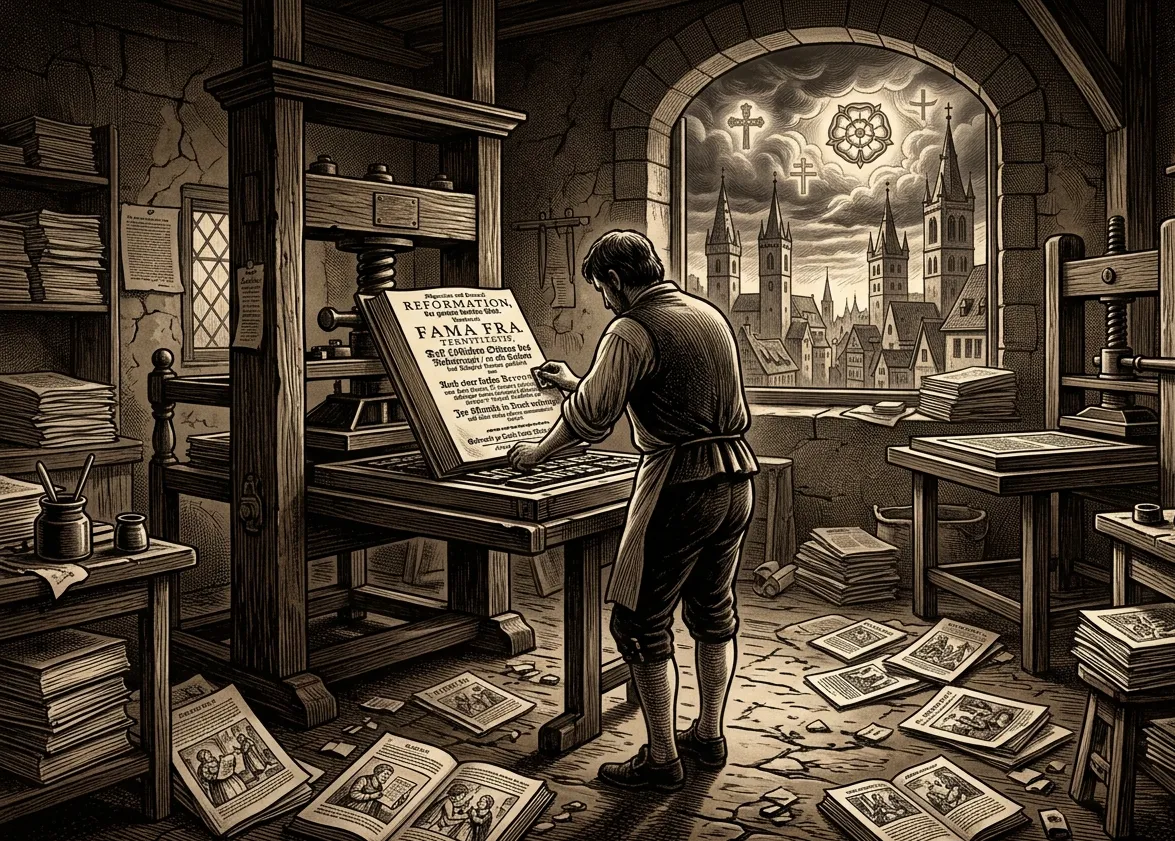
In 1614, a small pamphlet appeared in Kassel, Germany, printed by Wilhelm Wessel and titled "Fama Fraternitatis, or A Discovery of the Fraternity of the Most Laudable Order of the Rosy Cross." It claimed to announce, on behalf of a secret brotherhood that had existed for over a century, that the time had come for a general reformation of the world.
The Fama told a story. A German nobleman named Christian Rosenkreuz, born in 1378, had traveled to Damascus, Damcar, Fez, and Spain, studying with Arab and African sages and collecting the wisdom of the Orient. Returning to Germany, he founded a small brotherhood dedicated to healing the sick for free, wearing no distinctive costume, keeping the existence of the fraternity secret for a hundred years, and meeting once a year. Christian Rosenkreuz himself had died in 1484 but his perfectly preserved body had recently been discovered in a secret vault, along with a library of arcane wisdom, when the fraternity was renovating their headquarters.
The pamphlet invited scholars, philosophers, and seekers throughout Europe to make contact with the Brotherhood of the Rosy Cross (Rosae Crucis). If they were genuinely interested in the reformation of knowledge and the healing of humanity, the Rosicrucians would find them.
Within a year, a second pamphlet appeared: "Confessio Fraternitatis" (1615), elaborating the Brotherhood's theological and philosophical principles. Then, in 1616, came "The Chymical Wedding of Christian Rosenkreuz," a more elaborate allegorical narrative of a seven-day initiation journey, later attributed to a young Lutheran pastor named Johann Valentin Andreae.
Europe went genuinely strange. Hundreds of people published pamphlets either announcing they had contacted the Rosicrucians, proclaiming themselves members, denouncing the Brotherhood as demonic, or desperately seeking admission. Philosophers and scholars throughout Germany, France, England, and the Netherlands wrote publicly begging to be accepted. The Rosicrucians published nothing in response. When the mathematician and philosopher Marin Mersenne (René Descartes' closest friend and correspondent) tried to track down Rosicrucians in Paris, he could find no one who admitted to membership.
The Brotherhood, insofar as it existed, was invisible.
## The Thirty Years' War and the Political Context
To understand what the manifestos were doing, you have to understand the moment into which they appeared.
The Thirty Years' War (1618-1648) was imminent, and the tensions driving it were already palpable. The Peace of Augsburg in 1555 had produced an unstable settlement between Catholic and Protestant territories in the Holy Roman Empire. The Calvinist Reformation had complicated the simple Catholic/Lutheran binary. Alchemical, Paracelsian, and Hermetic ideas had spread through Protestant intellectual circles as alternatives to both Catholic scholasticism and orthodox Lutheran theology. Something was looking for a new synthesis.
The Rosicrucian manifestos spoke directly to this hunger. They promised a reformation that went beyond Luther's reformation of doctrine: a reformation of the entire relationship between human knowledge and divine wisdom, incorporating the new sciences (Copernicus, Paracelsus, Dee) within a spiritual framework that could unify rather than further fragment Europe's fractured Christianity. Christian Rosenkreuz himself was a specifically Protestant figure, but the synthesis he represented was presented as transcending sectarian divisions.
The timing is too precise to be accidental. The manifestos appeared just before the political explosion. They proposed, with enormous urgency, that a secret network of reformed scholars was already quietly at work. If the war was coming, the reformation of knowledge might be the only thing that could provide a foundation for whatever came after.
## Francis Bacon, Johann Valentin Andreae, and the Question of Authorship
The question of who wrote the Rosicrucian manifestos is still contested, and the debate reveals a great deal about the intellectual networks of the early 17th century.
Johann Valentin Andreae (1586-1654), a Lutheran theologian and later superintendent of the Württemberg church, acknowledged authorship of "The Chymical Wedding" (though he later called it a "ludibrium," a jest or playful work, which may have been defensive distancing). His connection to the other two manifestos is suggestive but unproven. Andreae was part of a circle of Tübingen intellectuals who shared a vision of educational, scientific, and spiritual reform, and the manifestos' program matches their discussions closely.
The Francis Bacon connection is more speculative but persistently interesting. Bacon's "New Atlantis" (1627) describes a secret scientific foundation called Salomon's House operating in isolation from the world, dedicated to "the knowledge of Causes, and secret motions of things" for "the enlarging of the bounds of Human Empire." The structural and thematic parallels to the Rosicrucian Brotherhood are substantial. Bacon's reform program for science, laid out in the "Novum Organum" (1620), shares the manifestos' sense of standing at a historical turning point where accumulated knowledge is about to break through into a new era.
Whether Bacon had direct involvement in the manifestos, was influenced by them, or independently arrived at similar ideas through similar cultural influences is unclear. What is clear is that the Rosicrucian idea, the idea of a hidden network of enlightened reformers working patiently toward a general renovation of human knowledge, was precisely Bacon's idea. And that this idea, whether Rosicrucian or Baconian in origin, fed directly into the formation of the Royal Society in 1660, the institution that became the model for all subsequent scientific societies.
The secret brotherhood may never have existed as described. But the vision it articulated became real.
Related Articles