## The Number That Keeps Showing Up
Sacred Geometry: The Language Written in Stone
The Hidden DoctrineContent Disclaimer: This article contains speculative theories presented for entertainment. Readers are encouraged to form their own conclusions.
There is a ratio that ancient builders encoded into their most important structures, that Greek philosophers treated as a divine principle, and that mathematicians still find slightly unsettling. It is approximately 1.618, and it goes by several names: the Golden Ratio, Phi, the Divine Proportion. Once you learn to recognize it, you start seeing it everywhere. That's either because it's genuinely woven into the structure of reality, or because pattern-hungry human brains impose it on things that merely approximate it. Both possibilities are interesting.
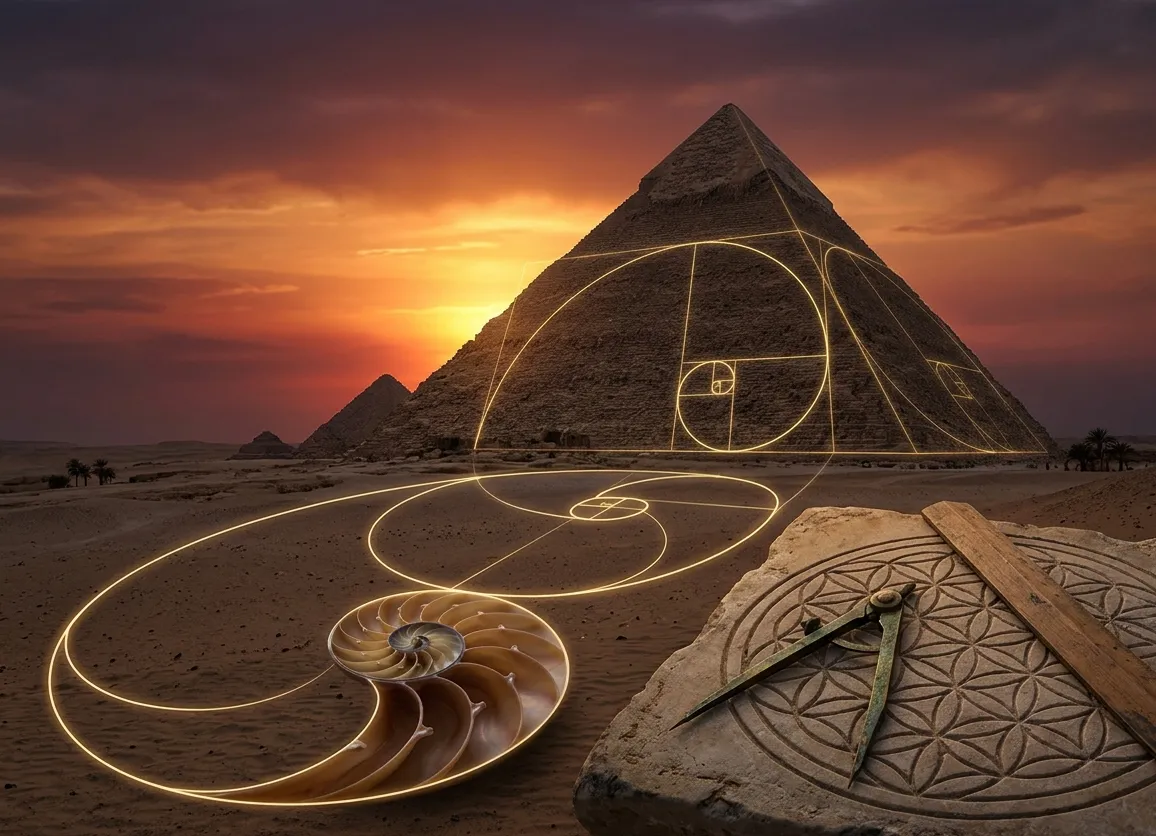
The Egyptians building the Great Pyramid at Giza around 2560 BCE produced a structure whose proportions encode Phi in several ways. The ratio of the slant height to half the base length gives you approximately 1.618. Whether this was intentional design or the natural result of using a rope with a fixed length to lay out proportions, the pyramid contains the ratio either way. The ancient builders may have intuited it before they could articulate it. Embodied knowledge often precedes formal knowledge.
The Pythagoreans of 6th century BCE Greece were different: they articulated it, and the articulation changed everything.
## Pythagoras and the Secret That Wasn't Just About Triangles
The famous theorem gets all the attention, but Pythagoras and his followers were doing something far stranger than calculating right triangles. They believed that reality was fundamentally numerical, that the cosmos was a mathematical structure and that understanding its numbers and ratios was identical to understanding God.
The discovery that upset everything was irrational numbers. The Pythagoreans held that all things could be expressed as ratios of whole numbers. Then one of their own, probably Hippasus, proved that the square root of two cannot be so expressed. It is irrational: its decimal expansion goes on forever without repeating. Some accounts say Hippasus was drowned for revealing this. Whether or not that's literally true, the story captures the emotional weight of the discovery. There were numbers that didn't fit the clean model. The universe had a wild edge.
Phi is irrational too. Its decimal expansion never ends, never repeats. Yet it generates the most orderly patterns in nature: the spiral arrangement of sunflower seeds, the branching of trees, the chambered nautilus. The irrational number produces the most rational-looking structures. This paradox delighted the ancients and still deserves more attention than it gets.
Plato, deeply influenced by Pythagorean thought, proposed in the Timaeus that the Creator used geometric forms as the templates for physical reality. The five regular solids that can be constructed in three dimensions (tetrahedron, cube, octahedron, dodecahedron, icosahedron) were assigned to the classical elements: fire, earth, air, cosmos, water. These became known as the Platonic Solids, and their perfection, the fact that only five such solids exist, suggested to Plato that they weren't human inventions but divine discoveries.
## From Athens to Chartres: Geometry as Theology
The knowledge didn't stay in the Academy. It moved.
Medieval cathedral builders worked in a tradition that was explicitly theological and geometric simultaneously. The great Gothic cathedrals of France weren't just big churches. They were, in the understanding of their architects, geometry made physical: the proportions of heaven made tangible in stone so that ordinary people who couldn't read could nonetheless receive the message through their bodies.
Chartres Cathedral, built between 1194 and 1220, is a textbook of sacred geometry. Its floor plan encodes Pi in the relationship between the labyrinth's diameter and the distance from the labyrinth to the west rose window. The proportional relationships between nave, transept, and choir follow ratios that appear again and again in nature. The architects called this Ars Geometria, the art of geometry, and they treated it as a sacred science passed down from the builders of Solomon's Temple.
They weren't wrong that it was ancient. The Vitruvian tradition in Roman architecture had been transmitting geometric principles since the 1st century BCE, and that tradition reached back through Greek architects to Egyptian temples where similar proportional systems had been in use for millennia.
## The Flower of Life and Metatron's Cube
Some of the most widely discussed sacred geometric forms today are also among the oldest. The Flower of Life, a pattern of overlapping circles arranged in a hexagonal grid, appears carved into stone at the Temple of Osiris at Abydos in Egypt, at the Forbidden City in China, at the Golden Temple in Amritsar, and in dozens of other sacred sites across the ancient world.
The pattern is geometrically remarkable. It contains within it the Fruit of Life (thirteen circles that form the basis for all the Platonic Solids), and when you connect the centers of the Fruit of Life with lines, you generate a figure called Metatron's Cube. From this single figure, all five Platonic Solids can be derived. This isn't a mystical claim. It's a geometric fact that anyone can verify with a compass and straightedge.
The question the ancients were asking was why: why do these relationships keep appearing? Why does the same pattern show up in the temple and the shell and the galaxy? They believed the answer was that geometry was the language in which creation was written. Not metaphorically. Literally.
The builders of Chartres, the architects of the Parthenon, the engineers of Giza weren't just trying to make beautiful buildings. They were trying to instantiate, in physical form, the underlying mathematical structure of reality. The buildings were prayers written in the only language they believed the cosmos understood.
Whether they were right is a question we're still not equipped to fully answer.
Related Articles