Content Disclaimer: This article contains speculative theories presented for entertainment. Readers are encouraged to form their own conclusions.
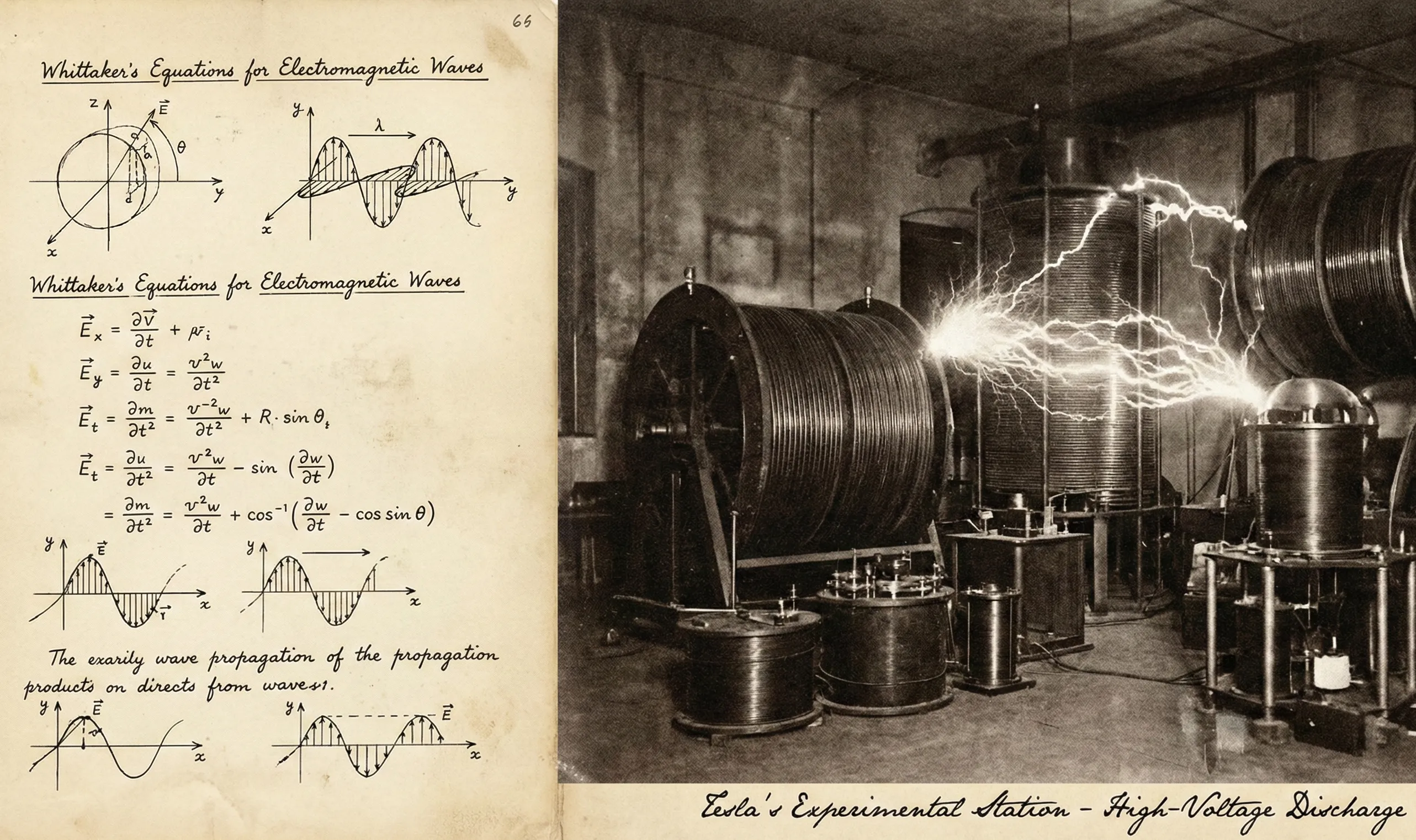
In 1903, mathematician Edmund Whittaker published a paper showing that any electromagnetic field could be decomposed into two scalar potentials. This mathematical result lay dormant for decades, a curiosity without obvious application.
Conventional electromagnetic waves are transverse. The electric and magnetic fields oscillate perpendicular to the direction of propagation. This is the light we see, the radio we hear, the microwaves that heat our food.
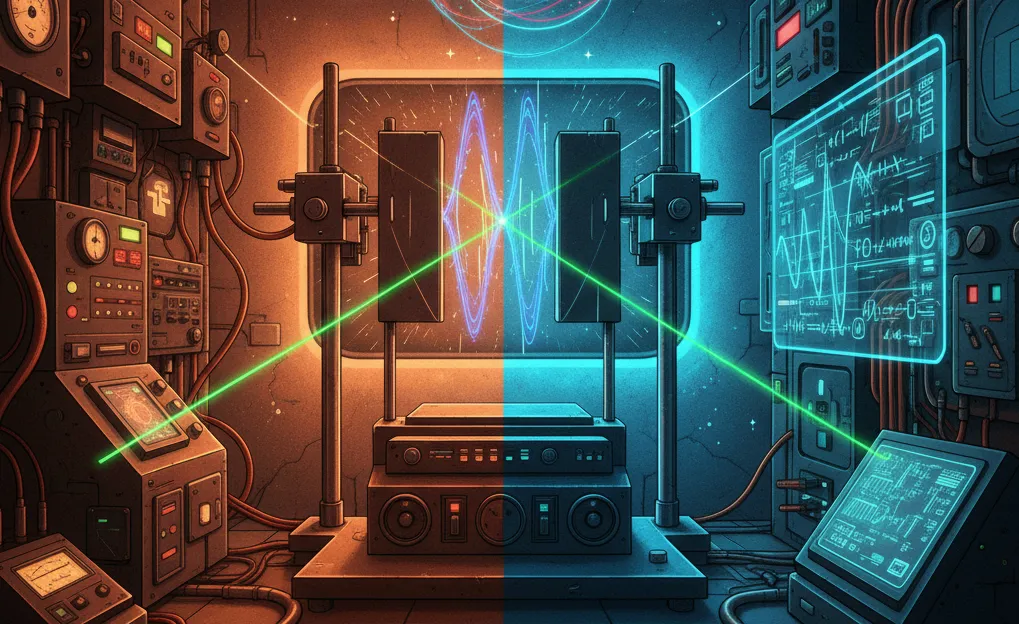
But Whittaker's mathematics suggested another possibility. Longitudinal waves, oscillating in the direction of travel rather than perpendicular to it. Scalar waves, carrying energy without conventional electromagnetic fields.
Standard physics dismissed this possibility. Maxwell's equations, as conventionally interpreted, do not permit such waves in free space. They can exist in plasma and certain other media, but not propagating through vacuum.
> The question was whether Maxwell's equations captured all of electromagnetic reality, or only part of it.
Nikola Tesla claimed to have produced longitudinal waves in his high voltage experiments. He described energy transmission that did not diminish with distance the way conventional radiation does. His claims were never independently verified.
The Soviet Union reportedly investigated scalar wave weapons during the Cold War. Tom Bearden, a retired U.S. Army lieutenant colonel, spent decades arguing that the Soviets had developed scalar interferometry technology based on Whittaker's work.
Bearden claimed scalar waves could transmit energy without loss, create force fields, manipulate weather, and even affect human consciousness. His books presented elaborate theoretical frameworks connecting suppressed physics to geopolitical events.
Mainstream physics rejected these claims entirely. Bearden's theories violated conservation laws and contradicted well tested aspects of electromagnetic theory. His evidence consisted largely of reinterpreting public events as secret weapon demonstrations.
But Bearden attracted a following. Engineers and physicists, some with impressive credentials, found his arguments intriguing. The existence of a small community of scalar wave researchers persists to this day.
The boundary between unconventional physics and pseudoscience is not always clear. Scalar wave theories sit uncomfortably on that boundary.
Related Articles