Content Disclaimer: This article contains speculative theories presented for entertainment. Readers are encouraged to form their own conclusions.
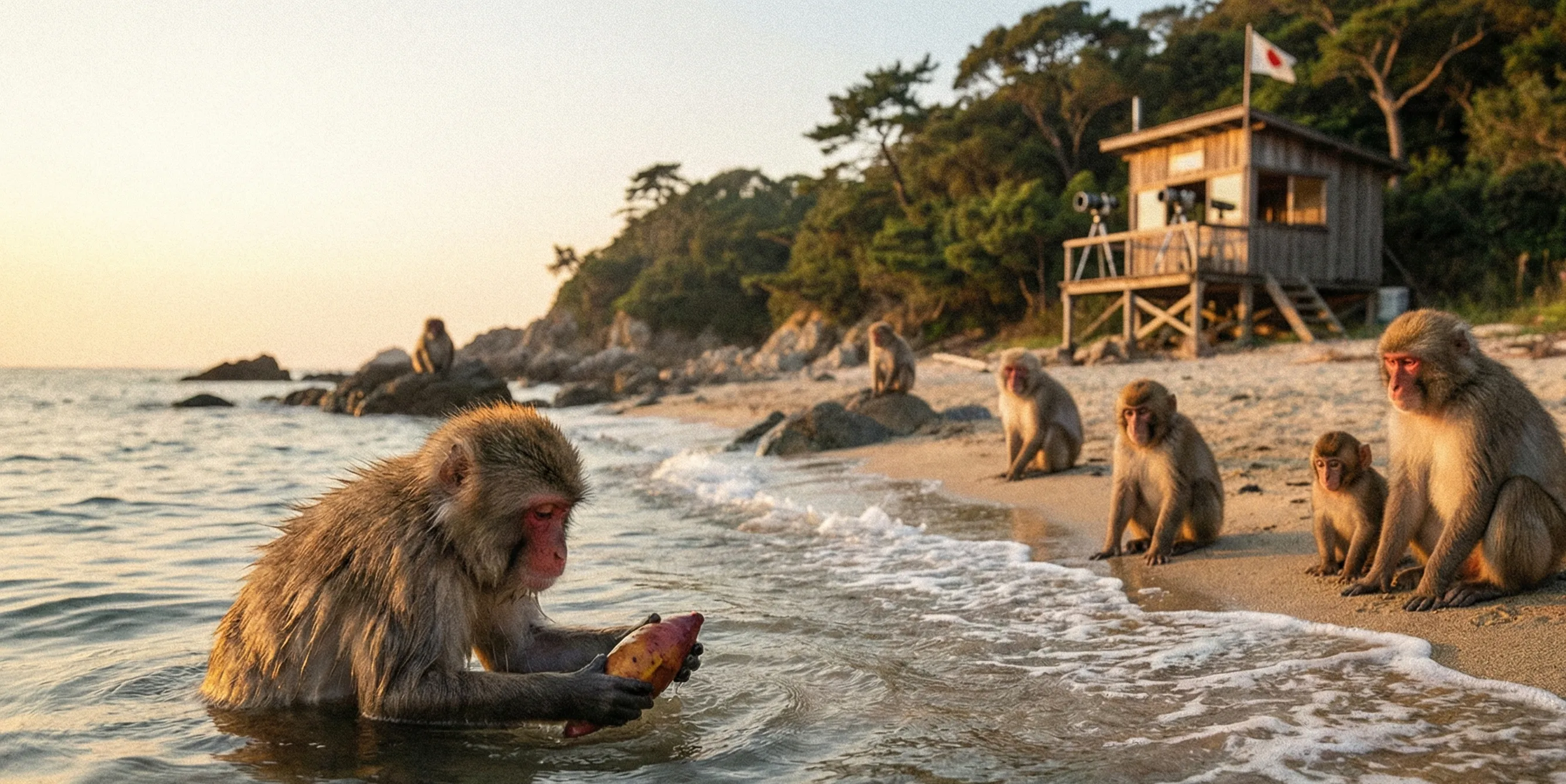
In 1952, Japanese scientists began a long term study of macaque monkeys on the island of Koshima. They provided the monkeys with sweet potatoes dropped in the sand. The monkeys liked the potatoes but not the grit.
One day, a young female named Imo made a discovery. She carried her potato to a stream and washed it. Clean potato. No sand. Simple innovation.
Imo taught the behavior to her mother. Then to her playmates. Slowly, over years, the practice spread through the troop. Young monkeys learned from their mothers. The innovation moved through social networks the way innovations do.
This was interesting primate behavior research. But it was not yet a phenomenon.
That came later.
In 1979, a South African writer named Lyall Watson published a book called Lifetide. In it, he described the Koshima research but added a remarkable claim. When a critical number of monkeys learned to wash potatoes, he wrote, something extraordinary happened. The behavior suddenly appeared in monkey populations on other islands. Monkeys with no contact with the Koshima troop. No way to have learned through observation.
Watson suggested that when the hundredth monkey learned the behavior, it crossed a threshold. The knowledge became available to all monkeys everywhere. Instantaneously. Through some kind of collective consciousness.
The story exploded. It became one of the most cited examples of mysterious connection between minds. If monkeys could share knowledge without physical contact, what might be possible for humans?
The tale appeared in self help books, spiritual treatises, and discussions of human potential. It suggested that individual change could trigger collective transformation. That when enough people shifted their thinking, a tipping point would be reached. The whole species would shift.
It was a beautiful idea. Empowering. It made every person's growth meaningful to the whole.
There was just one problem.
It never happened.
Ken Keyes Jr. popularized the story in his 1982 book The Hundredth Monkey. He used it as a parable for nuclear disarmament. If enough people opposed nuclear weapons, perhaps that opposition would spread spontaneously. Critical mass leading to instant change.
The story took on a life of its own. It was repeated in contexts far from its origin. Peace movements. Environmental activism. Personal development seminars. Everywhere people wanted to believe that consciousness could shift suddenly across populations.
Meanwhile, skeptics began asking questions. Where did Watson get his data? What were his sources?
When they looked closely, they found the story had no foundation.
Related Articles