Content Disclaimer: This article contains speculative theories presented for entertainment. Readers are encouraged to form their own conclusions.
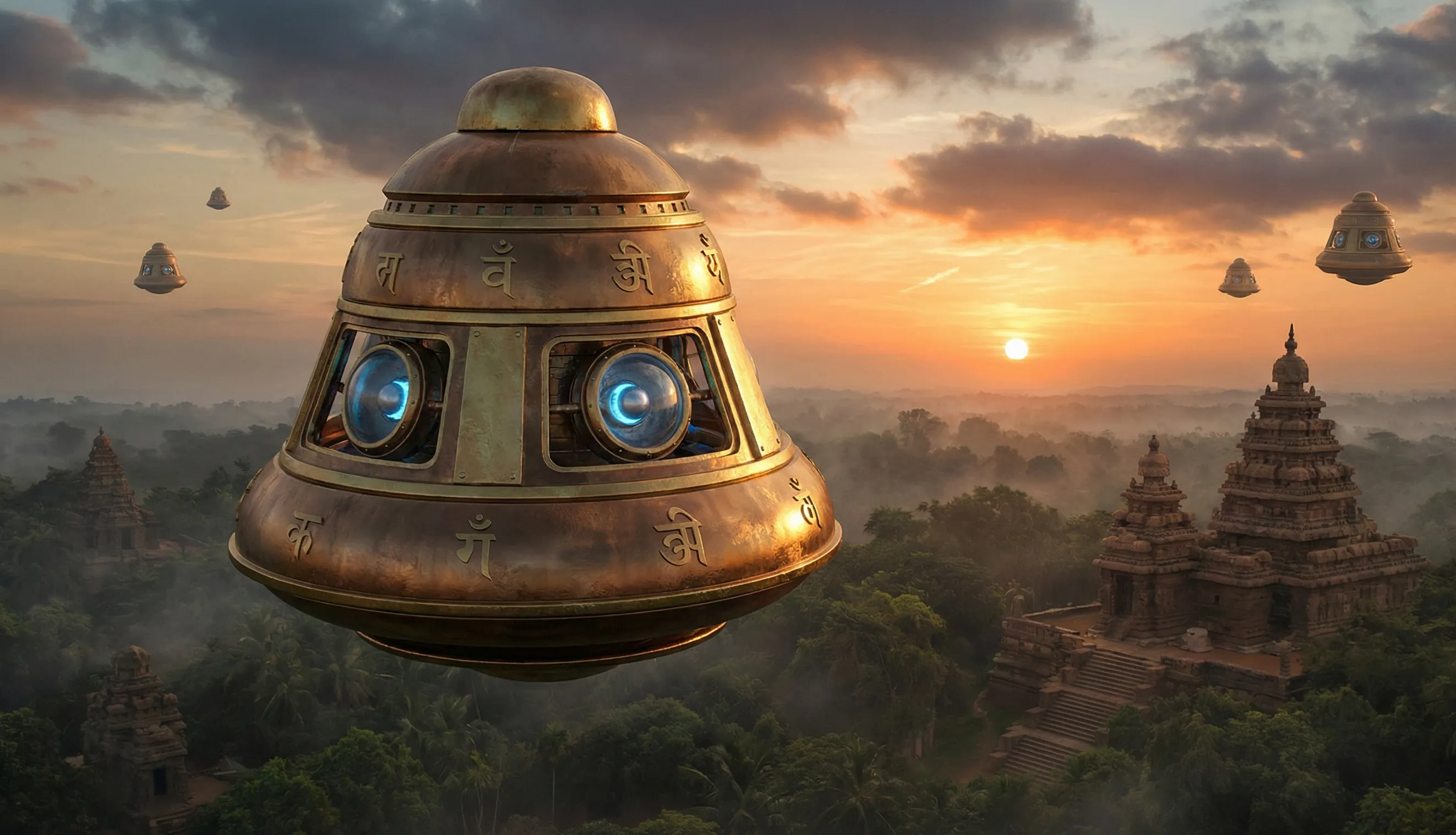
Long before the Wright Brothers took flight, long before humanity dreamed of conquering the skies, ancient Sanskrit texts described flying machines with technical precision that defies conventional history. The Vimanas-measured passages through the air-were not metaphors. They were blueprints.
The Ramayana, composed over 5,000 years ago, describes Ravana's celestial vehicle, the Pushpaka Vimana, in terms that sound disturbingly familiar to modern aerospace engineers. Built by the gods themselves, this craft shone like gold in the sunlight, moving at the speed of thought, making sharp maneuvers that would make contemporary fighter jets look primitive.
Its interior space expanded or contracted based on the number of passengers. It could travel from ground level to the heavens in moments. The text describes it with technical language, not poetic flourish. Measured dimensions. Specific capabilities. Operational parameters.
This was not mythology. This was documentation.
The Mahabharata goes further. When Arjuna is summoned by the gods, a Vimana descends to transport him to celestial realms. The description matches modern accounts of aerial vehicles-bright lights, powerful propulsion, the ability to hover and accelerate vertically.
Arjuna travels to various kingdoms in the sky, meets different classes of beings, receives advanced weapons, learns tactical knowledge unavailable on Earth, then returns via the same vehicle. The text treats this as historical fact, not allegory.
Every major deity in the Sanskrit epics possessed their own Vimana. Krishna's Sudarshana was designed specifically for aerial combat. Indra commanded an entire fleet. The variety of designs suggests different models for different purposes-reconnaissance, transport, warfare.
The Vaimanika Shastra, a text allegedly based on even older sources, contains technical specifications that read like an aerospace engineering manual. Descriptions of metals, propulsion systems, energy sources, piloting techniques. Skeptics dismiss it as a 20th-century fabrication, but the knowledge it contains predates modern aviation by decades.
It describes mercury vortex engines. Electromagnetic field manipulation. Anti-gravity propulsion through rotating liquid metal at high speeds. Concepts that wouldn't enter mainstream physics until the mid-1900s.
The text even details different categories of Vimanas. The Shakuna type-bird-like craft designed for atmospheric flight. The Sundara-beautiful vehicles for passenger transport. The Rukma-military models built for speed and maneuverability. The Tripura-massive aerial cities housing thousands.
That last category appears most prominently in the Bhagavata Purana. Three flying cities controlled by the Asuras-beings later demonized as enemies of the gods. These weren't small craft. They were mobile fortresses, aerial civilizations from which the Asuras waged war against both divine beings and humans.
The texts describe pitched battles in the skies. Vimanas clashing with weapons that created explosions brighter than a thousand suns, leaving areas uninhabitable for years. Cities destroyed in single attacks. Entire populations vaporized.
The description of these weapons matches nuclear detonation with terrifying accuracy. Blinding light. Scorching heat that melts stone. Radiation sickness among survivors-hair and nails falling out, vomiting, death within days. The Mahabharata describes this in excruciating detail.
Eventually, the god Shiva ends the war by firing a cosmic arrow-the Brahmashtra-at the flying city of Tripura, destroying it in a cataclysmic explosion. The aftermath described in texts mirrors nuclear winter. Darkness covering the earth. Crops failing. Mass starvation.
This wasn't primitive imagination. Primitive cultures don't fantasize about radiation poisoning. They describe what they see, what they experience, using the vocabulary available to them.
The propulsion technology described in these texts centers on mercury. The Vaimanika Shastra specifically details mercury vortex engines-containers of liquid mercury spun at high speeds to create electromagnetic fields capable of manipulating gravity.
Mercury appears in connection with ancient technology across multiple disconnected cultures. The Chinese associated it with immortality and the gods. Mesoamerican pyramids like Teotihuacan have mercury channels beneath them. Hindu texts describe it as Shiva's essence, used in alchemical processes.
Why mercury? Modern physics recognizes that spinning conductive fluids can generate electromagnetic fields. Superconducting materials-which mercury becomes at low temperatures-exhibit quantum locking and magnetic levitation. Technologies we're only beginning to explore.
The ancients weren't guessing. They were documenting.
The Yantra Purusha concept adds another layer. Some translations interpret this as autonomous Vimanas-self-piloting craft controlled by mechanical intelligence. Whether this means sophisticated autopilot systems or something more advanced remains debated, but the texts clearly describe vehicles capable of operating without direct human control.
The geographic distribution of these accounts is telling. Sanskrit texts from India. Sumerian cylinder seals showing gods in celestial barques. Egyptian hieroglyphs depicting flying boats of Ra. Mesoamerican art showing feathered serpents descending from the sky. Native American legends of sky people in shining craft.
Different cultures. Different languages. Different continents. Same core narrative-beings with advanced technology traveling through the air and between worlds.
The technology wasn't theoretical. Archaeological evidence at multiple sites shows precision cutting of extremely hard stone, transportation of multi-ton blocks across impossible terrain, astronomical alignments requiring aerial surveys. Construction techniques that make sense only if builders had aerial capability.
How else do you survey and align Giza's pyramids to true north with 3/60th of a degree accuracy? How do you map ley lines connecting Angkor Wat, Nazca, Easter Island, and Giza unless you can see the Earth from above?
The Vimanas weren't just transportation. They were the foundation of a technological civilization that global catastrophe erased from history. The Younger Dryas impact, the Great Flood, whatever cataclysm ended the last ice age-it destroyed the infrastructure but couldn't erase the memory.
Those memories became myths. Myths became religion. Religion simplified complex technology into magic. But dig deep enough into the oldest texts, before centuries of translation and reinterpretation, and you find technical manuals describing machines that flew.
The gods weren't supernatural. They were technological. Their powers weren't miracles. They were engineering. And the Vimanas weren't divine chariots. They were aircraft that humanity once built, once flew, once fought wars with-until catastrophe reduced us to starting over from scratch.
The knowledge survived in fragments. Hidden in myths. Encoded in temples. Waiting for the day when humanity would advance enough to recognize what our ancestors tried to preserve. The day we would read these ancient texts not as fantasy, but as history.
That day is now.
Related Articles