Content Disclaimer: This article contains speculative theories presented for entertainment. Readers are encouraged to form their own conclusions.
In 1913, Max Planck and Albert Einstein made a peculiar discovery while studying blackbody radiation. Even at absolute zero, when all thermal motion should cease, something remained. A residual energy that could not be extracted or eliminated. They called it nullpunktsenergie. Zero point energy.
The finding seemed like a mathematical artifact at first. A curious footnote in the equations of quantum mechanics. But as physicists probed deeper into the nature of the vacuum, they found it was anything but empty.
Werner Heisenberg's uncertainty principle explained why. You cannot simultaneously know both the position and momentum of a particle with perfect precision. This fundamental limit means particles can never be completely still. Even in a perfect vacuum at absolute zero, quantum fluctuations persist.
The vacuum seethes with activity. Virtual particles pop into existence and annihilate each other in timeframes too short to measure directly. Electromagnetic fields fluctuate even when no photons are present. The emptiest space in the universe is filled with energy.
> The vacuum is not nothing. It is the lowest energy state of everything.
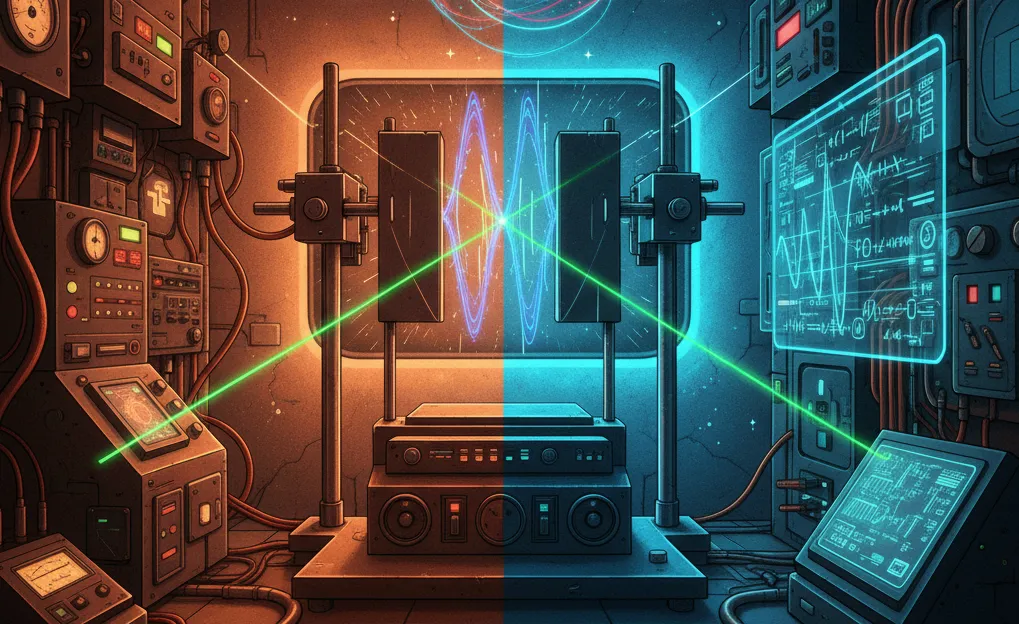
Dutch physicist Hendrik Casimir proposed a way to detect this energy in 1948. Place two uncharged metal plates very close together in a vacuum. The quantum fluctuations between the plates would be restricted while those outside remained unrestricted.
This imbalance would create a measurable force pushing the plates together. The Casimir effect.
Skeptics doubted such a subtle force could be detected. The plates would need to be separated by mere nanometers. Any contamination or imperfection would overwhelm the signal.
But in 1997, Steve Lamoreaux at Los Alamos measured the Casimir effect with extraordinary precision. The force matched theoretical predictions to within five percent.
The energy of the vacuum was real. Measurable. Undeniable.
This raised an obvious question. If empty space contains energy, could we extract it? Could the quantum vacuum become a power source?
Mainstream physics said no. Zero point energy is by definition the lowest possible energy state. You cannot extract energy from something that is already at the bottom. There is no lower state to fall to.
But some researchers disagreed. They proposed mechanisms that might allow tapping this vast reservoir. Patents were filed. Companies were founded. Claims were made.
The scientific establishment remained skeptical. Extraordinary claims require extraordinary evidence. And the evidence remained elusive.
Related Articles