Content Disclaimer: This article contains speculative theories presented for entertainment. Readers are encouraged to form their own conclusions.
November 1956. Science Fiction Quarterly publishes a short story by Isaac Asimov. He would later call it his favorite work.
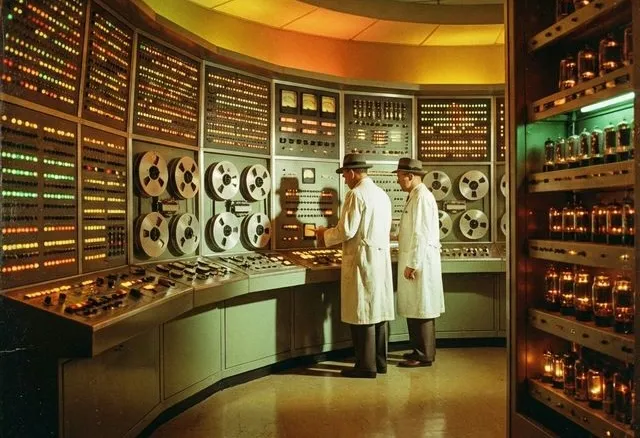
The story begins in 2061. Two engineers stand before Multivac, the most advanced computer ever built. They've just witnessed humanity's greatest achievement: the harnessing of solar energy, finally giving civilization access to seemingly unlimited power.
But one engineer raises a troubling point. Nothing is truly unlimited. Even the sun will die. Every star will eventually burn out. The universe itself is running down.
This is entropy. The fundamental principle that all organized systems decay into disorder. Heat dissipates. Energy disperses. Order becomes chaos. Given enough time, the universe will fade into a cold, dark void where even atoms lose their bonds.
So they ask Multivac the obvious question. Can entropy be reversed?
The machine processes. Its lights flicker. After what feels like an eternity, it responds.
THERE IS AS YET INSUFFICIENT DATA FOR A MEANINGFUL ANSWER.
Asimov then does something remarkable. He follows this question across trillions of years. Different eras. Different humans. Different versions of the computer. The technology evolves from room-sized machines to personal devices to networks that span galaxies. Humans themselves transform, first extending their lives, then transcending their biological forms entirely.
But the question remains the same. And so does the answer.
Insufficient data.
What Asimov was really asking wasn't about thermodynamics. He was asking about the limits of intelligence. Whether any mind, no matter how vast, could ultimately solve the unsolvable. Whether knowledge itself has a ceiling.
In 1956, this was pure speculation. Computers barely existed. The idea of artificial intelligence was just emerging in academic circles. John McCarthy and Marvin Minsky had coined the term that same year.
Asimov couldn't have known how relevant his question would become.
Related Articles