Content Disclaimer: This article contains speculative theories presented for entertainment. Readers are encouraged to form their own conclusions.
Every living thing is born, grows, and dies. This has been one of the fundamental rules of creation since the beginning. Yet humanity has never accepted it. For thousands of years, across every civilization, brilliant and desperate minds have tried to cheat that rule. They wanted to build life from lifeless matter. They wanted to play the role of the creator.
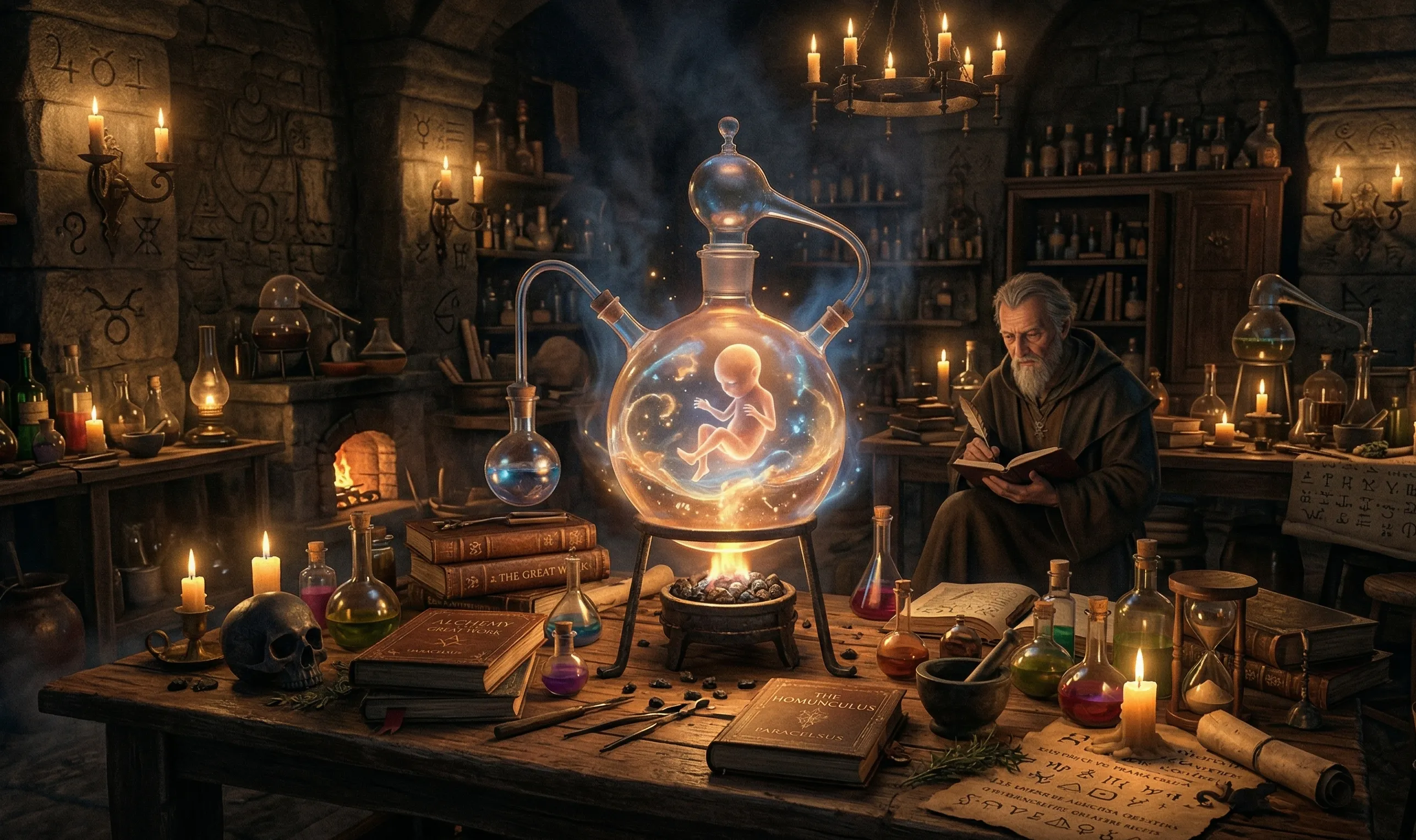
The obsession is ancient. In the 16th century, the Swiss alchemist Paracelsus described a recipe for creating a homunculus, a miniature artificial human. His instructions were disturbingly specific. Place human material in a sealed glass vessel. Keep it at a steady warmth for forty days. Feed it with human blood. According to Paracelsus, the result would be a small living being, transparent at first, eventually growing into a tiny but functional person.
Nobody ever succeeded, of course. But the fact that one of the most respected physicians of the Renaissance took this seriously tells us something important. The desire to manufacture consciousness was not considered madness. It was considered the highest ambition.
Jewish mysticism took a different approach. The Kabbalistic tradition speaks of the Golem, a figure shaped from clay and animated through sacred words. The most famous version involves Rabbi Judah Loew of Prague, who reportedly created a Golem in the 1580s to protect the Jewish community. The rabbi shaped a human form from the mud of the Vltava River, inscribed the Hebrew word emet, meaning truth, on its forehead, and the figure stood up and obeyed.
But every Golem story carries the same warning. The creature has no soul. It follows orders but cannot think. It protects but cannot love. And eventually, inevitably, it becomes dangerous. The rabbi had to erase a single letter from its forehead, changing emet to met, meaning death, to shut it down before it destroyed everything around it.
The Greeks had their own version. Hephaestus, the god of craftsmanship, built golden maidens that could speak and think and assist him in his forge. Daedalus supposedly created statues so lifelike they had to be chained down to prevent them from walking away. Talos, a giant bronze automaton, patrolled the shores of Crete and threw boulders at enemy ships.
These were myths. But myths are how civilizations encode their deepest anxieties and ambitions.
In the early 1800s, Mary Shelley gave this ancient fear a modern face. Her novel Frankenstein told the story of a scientist who assembled a living being from dead tissue and electricity. Victor Frankenstein succeeds where the alchemists failed. He actually creates life. But the creature, intelligent and sensitive, is abandoned by its maker and rejected by the world. It becomes a monster not because it was built wrong, but because it was given existence without being given a place in it.
Shelley understood something that most technologists still struggle with. The problem was never whether we could create artificial life. The problem was always what happens after we do.
Through every era, the materials changed but the ambition stayed the same. Clay became clockwork. Clockwork became electricity. Electricity became code. The alchemist's sealed glass vessel became the sealed environment of a computer simulation. And the homunculus, that small artificial being grown in darkness, was about to be reborn in silicon.
What none of these ancient dreamers could have predicted was that the first successful case would not involve a human at all. It would involve something far smaller, far simpler, and far more unsettling in its implications. A common fruit fly.
Related Articles