Content Disclaimer: This article contains speculative theories presented for entertainment. Readers are encouraged to form their own conclusions.
In the summer of 1992, a farmer named Wu Anai lived near the village of Shiyan Beicun, in Longyou County, a quiet stretch of Zhejiang Province in southeastern China. He had grown up watching a cluster of local "ponds" that nobody seemed to use, that nobody fished in, that animals tended to avoid. Locals called them tianmen, heavenly pits, and assumed they were just deep natural pools filled with spring water. Wu was curious. He was also stubborn.
He rented a pump. It took him seventeen days.
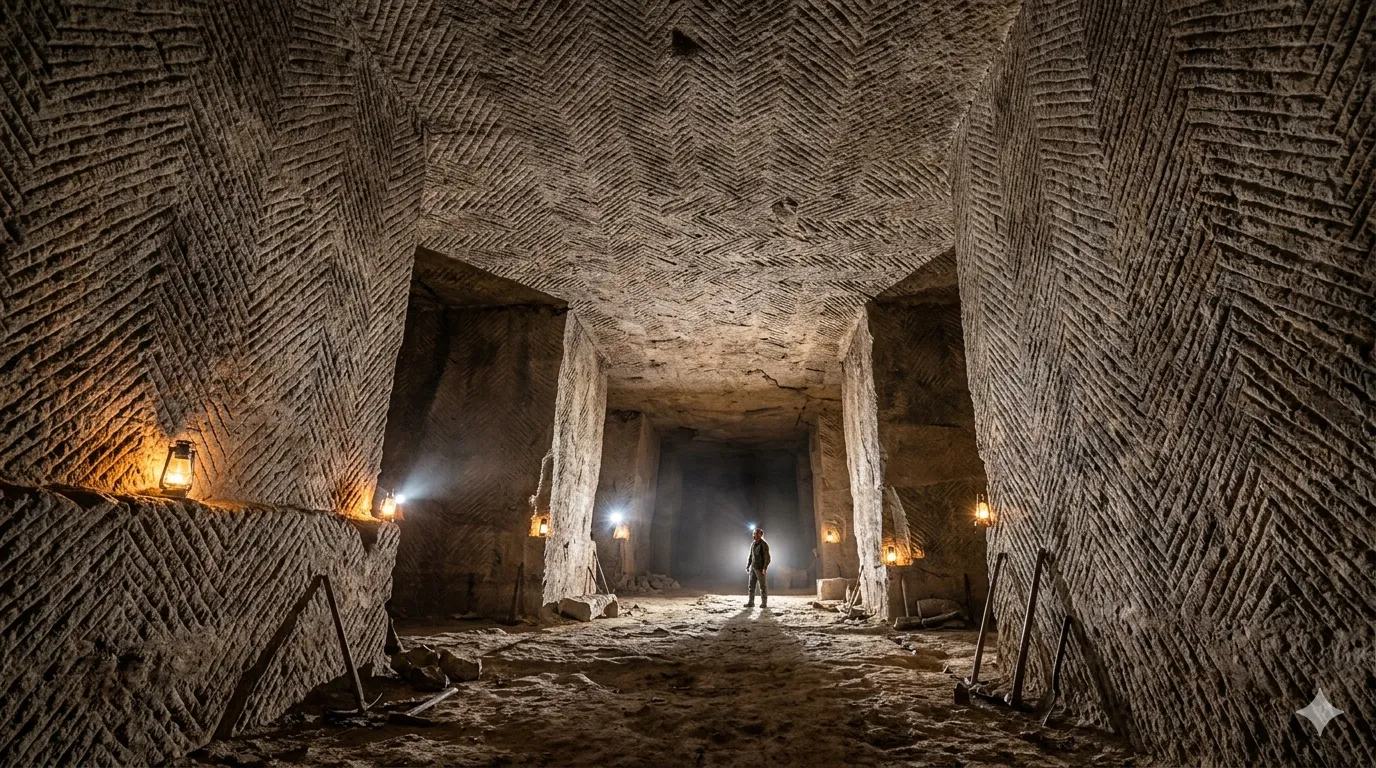
When the water finally dropped far enough, Wu Anai climbed down into the first cavity and found himself standing inside something that had no right to exist. It was a vast man-made chamber, carved entirely from living rock, stretching more than twenty meters high and wide enough to swallow a small building. Every surface, from the floor to the vaulted ceiling, was covered in a repeating pattern of parallel chisel marks, angled at precisely 45 degrees, like the grain of some enormous stone textile.
He had uncovered one of the Longyou Caves. Or rather, the first of them.
Over the following months, local residents and then archaeologists began systematically draining the other ponds scattered across the same area. The results were always the same. Each flooded depression turned out to be the roof of another immense carved chamber. By the time researchers had properly catalogued the site, they had confirmed at least 36 individual caves. Together, the excavated chambers cover more than 30,000 square meters of underground space, roughly the floor area of four full-sized football fields.
The caves are not primitive. They are not rough-hewn holes gouged into the ground by desperate hands. They are engineered spaces. Each one has at least four stone columns left standing as structural supports, carved in place from the living rock rather than installed afterward. The ceilings form elegant arched vaults. The floors are level. The walls lean inward at a consistent angle, giving each cave a trapezoidal cross-section. In several chambers, there are stone platforms, stone pools, stone stairways carved directly from the bedrock.
And then there is the texture. Those chisel marks, angled at 45 degrees, running in parallel lines no more than a few centimeters apart, cover virtually every surface without exception. They appear on the floors, the walls, the columns, the ceilings. They are so consistent across all 36 caves that researchers believe the same technique, possibly the same tools or even the same teams, was used throughout. What is not clear is why. Decorative? Structural? Ritualistic? Acoustic? Nobody knows.
What makes all of this stranger is the silence of history. The Longyou Caves are estimated to be somewhere between 2,000 and 2,500 years old, placing their likely construction in the Qin or early Han dynasty period. That is a well-documented era of Chinese history. There are written records of public works, military campaigns, taxation, floods, harvests. The construction of the Great Wall is documented. The building of the First Emperor's tomb complex at Xian is documented. But the Longyou Caves? Not a single historical record, inscription, or official chronicle from any dynasty mentions them. There is no entry in any local gazette. No founding myth. No folk memory that says anything more specific than "those ponds have always been there."
To carve 30,000 square meters of solid rock to this level of precision, using tools available in the period, would have required an enormous and organized workforce, likely tens of thousands of people working over years. The removal of the excavated stone alone would have been a logistical undertaking visible across the region. Where did all the stone go? Nobody has found it. There are no nearby quarry dumps, no ancient roads leading away from the site loaded with rubble.
They are, in other words, enormous. They are old. They are sophisticated. And they appear to have been built by a civilization that left no record of building them, in a place where records of that civilization exist in abundance. That is not a small puzzle. That is a gap in history wide enough to walk through.
Farmers had been walking past those flooded ponds for generations. They built their homes around them, farmed the fields above them, told their children they were just deep water. It took one stubborn man with a rented pump to change everything. What else might be sitting just beneath the surface of the ordinary world, patient and silent, waiting for someone to be curious enough to look?
Related Articles