
The Space Race Deception
The Moon Landing Deception: Hollywood's Greatest Secret?
Redacted RealitiesContent Disclaimer: This article contains speculative theories presented for entertainment. Readers are encouraged to form their own conclusions.
The year was 1969. The world was split in two. On one side, the capitalist West led by the United States; on the other, the communist East led by the Soviet Union. The Cold War was not just about nuclear stockpiles or proxy wars in Vietnam; it was a battle for the psychological domination of humanity. And the ultimate high ground in this battle was not on Earth, but above it.
To understand the magnitude of the Moon Landing conspiracy, one must first understand the desperation of the American government. The United States was losing the Space Race, and they were losing badly.
Despite Operation Paperclip, the secret intelligence program that brought over 1,600 German scientists, engineers, and technicians (including Wernher von Braun) to the U.S. after World War II, NASA was lagging behind. The Soviets were achieving the impossible, again and again.
October 4, 1957: The Soviets launched Sputnik 1, the first artificial satellite. Panic swept through Washington. The sky now belonged to the communists.
November 3, 1957: They launched Sputnik 2 with Laika, the first living creature in orbit.
April 12, 1961: Yuri Gagarin became the first human to journey into outer space. His famous words, "I see Earth! It is so beautiful," echoed as a humiliation in the halls of the White House.
Then came the first spacewalk by Alexey Leonov. The first woman in space, Valentina Tereshkova. The first soft landing on the Moon by an unmanned probe. The scorecard was completely one-sided. The Soviets were writing history, while American rockets were exploding on the launchpad.
In this climate of humiliation and fear, President John F. Kennedy made a gamble. In 1962, at Rice University, he delivered a speech that would define a generation: "We choose to go to the Moon in this decade and do the other things, not because they are easy, but because they are hard."
It was a brilliant political move, but technically, it was suicide. At the time of his speech, NASA didn't even know if a spacecraft could dock with another in orbit. They had no idea how to land on the lunar surface without sinking into dust. The computer technology required for guidance didn't exist yet. Kennedy had written a check that American science couldn't cash.
As the deadline of 1969 approached, the pressure became unbearable. The Vietnam War was draining the budget and the public's morale. America needed a win. A big win.
This is where the seeds of doubt were planted.
In 1976, a man named Bill Kaysing published a pamphlet titled "We Never Went to the Moon: America's Thirty Billion Dollar Swindle". Kaysing wasn't just a random conspiracy theorist; he had worked as a senior technical writer for Rocketdyne, the company that built the F-1 engines for the Saturn V rocket.
Kaysing raised disturbing questions. He cited internal memos and feasibility studies which allegedly calculated the chance of a successful manned lunar landing and return at less than 0.0017%. In engineering terms, that is virtually zero.
According to Kaysing, the technology simply wasn't there. The Saturn V was plagued with instability issues during testing. The Lunar Module (LM), a spider-like craft wrapped in gold foil, looked too fragile to survive the vacuum of space, let alone land and take off again.
If the technology couldn't deliver the promise, but the promise had to be kept for the sake of national survival, what was the alternative?
Enter the "Third Option": Simulation.
The theory goes that in 1968, the CIA and NASA realized they couldn't make the landing happen safely. But admitting defeat to the Soviets was unacceptable. It would mean the collapse of American prestige and potentially the loss of the Cold War.
So, they turned to the masters of illusion.
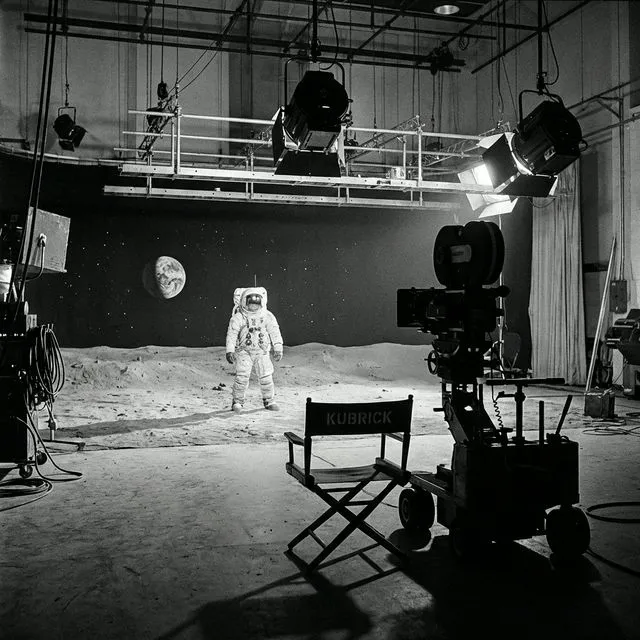
Hollywood in the late 60s was undergoing a revolution in special effects. And the undisputed king of this revolution was Stanley Kubrick. His 1968 masterpiece, "2001: A Space Odyssey", showcased visuals of space that were breathtakingly realistic. The lighting, the movement, the silence of the vacuum—Kubrick had captured it all.
The conspiracy theory suggests a secret deal. Kubrick, known for his perfectionism and reclusiveness, was allegedly approached by high-ranking officials. They offered him an unlimited budget for his future projects and total creative freedom. In exchange, he would direct the most important film in history: The Apollo 11 moonwalk.
Proponents of this theory point to the production technique known as "Front Projection", which Kubrick pioneered. This technique allowed actors to be filmed in a studio against a massive, high-resolution background projected onto a special reflective screen. It created depth and realism that traditional rear projection couldn't match.
When you look at the Apollo photos, skeptics argue, you are looking at Kubrick's signature style. The stark contrast. The dramatic lighting. The way the background seems to cut off abruptly.
Bill Kaysing argued that the Saturn V did launch—empty. It went up, out of sight, and crashed into the ocean or orbited empty. Meanwhile, the broadcast switched to a secure studio feed, possibly located in the Nevada desert or a soundstage in London.
The motive was clear: Win the Cold War at any cost. The Soviets, without their own presence on the Moon, could track the radio signals coming from the direction of the Moon, but they couldn't verify if a human was actually walking there.
This set the stage for the greatest debate of the modern era. Was it a triumph of human engineering, or the most successful psychological operation ever conducted? The questions didn't stop in the 70s. As technology advanced, the scrutiny of the evidence only intensified.
Related Articles




📋 Affiliate Disclosure
This article contains affiliate links. If you purchase a product or service through these links, we may earn a commission at no additional cost to you. We only recommend products we genuinely believe provide value to our readers. Our editorial content is not influenced by affiliate partnerships, and all opinions expressed are our own.