Content Disclaimer: This article contains speculative theories presented for entertainment. Readers are encouraged to form their own conclusions.
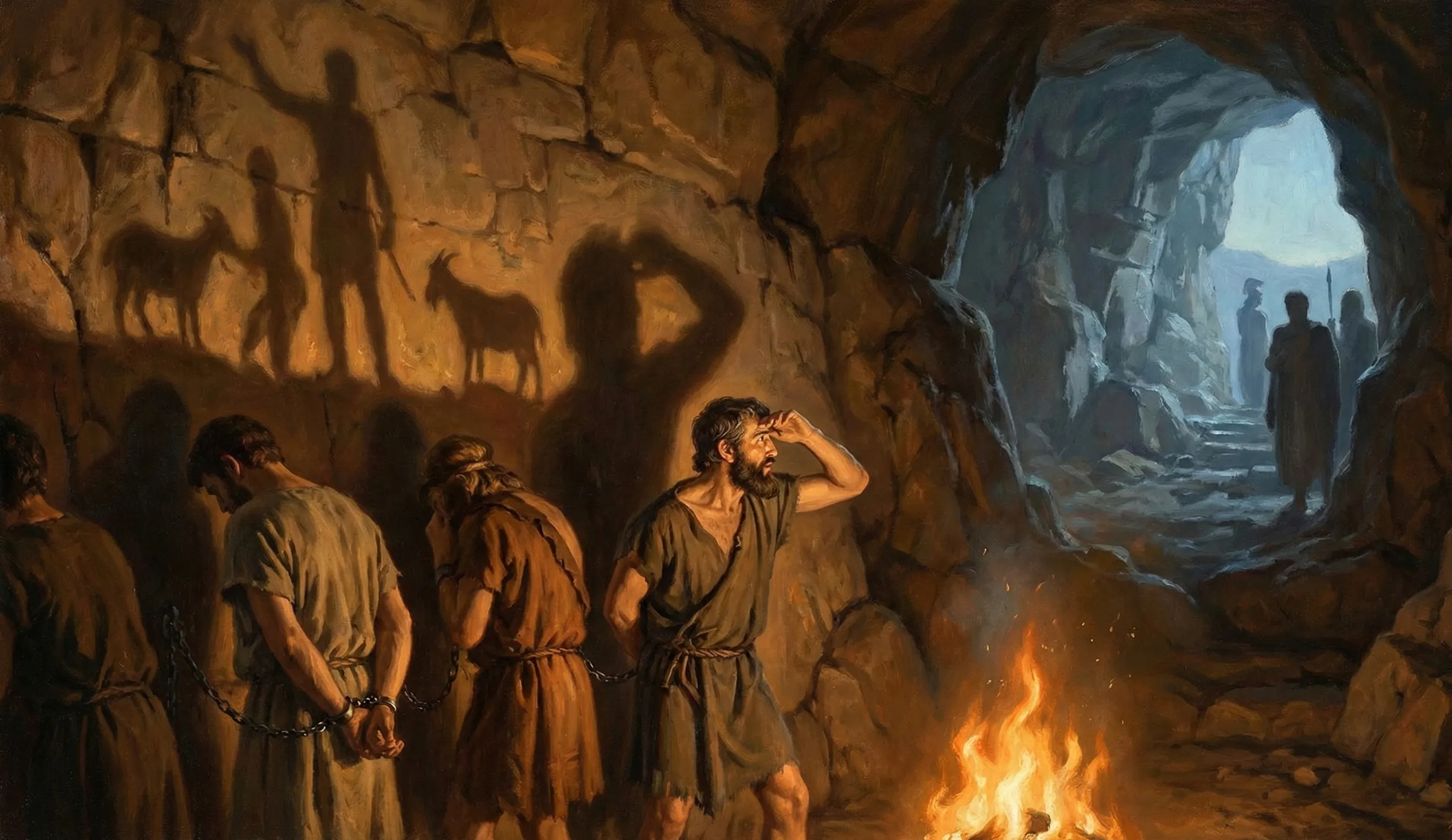
Imagine prisoners chained in a cave since childhood.
They face a wall. Behind them burns a fire. Between the fire and the prisoners, people walk carrying objects. The fire casts shadows of these objects onto the wall.
The prisoners cannot turn around. They cannot see the fire, the people, or the objects. They see only shadows. They hear only echoes.
For these prisoners, shadows are reality. They give the shadows names. They study their movements. They compete to predict which shadow will appear next. The most skilled predictors are honored as wise.
This is how Plato begins the allegory of the cave, written around 380 BC in his dialogue The Republic. It is perhaps the most influential thought experiment in Western philosophy.
The story continues.
One prisoner is freed. He turns and sees the fire. The light hurts his eyes. He struggles to understand that the objects casting shadows are more real than the shadows themselves.
Then he is dragged out of the cave entirely. Into sunlight. The pain is overwhelming. Gradually his eyes adjust. He sees trees, rivers, people. Finally he looks at the sun itself and understands that it is the source of all light and all visibility.
He realizes his entire previous existence was spent watching shadows of shadows. What he thought was reality was merely reflections of a deeper truth.
Now comes the difficult part.
He returns to the cave. He tries to explain to the other prisoners what he has seen. They think he is mad. His eyes, readjusted to sunlight, struggle in the darkness. He cannot see the shadows as well as they can.
The prisoners conclude that leaving the cave has damaged him. They resolve never to make the same mistake. If anyone tried to free them, Plato suggests, they would kill him.
Plato intended this as an allegory about philosophy and education. The cave represents the world of appearances. The sun represents the Form of the Good, the highest truth. The freed prisoner represents the philosopher who has glimpsed reality beyond ordinary perception.
But the allegory has resonated far beyond its original context. For 2,400 years, people have found in it something that speaks to their condition.
The sense that everyday life might be a shadow play. That deeper truths might exist beyond what we normally perceive. That those who have seen more might struggle to communicate with those who have not.
Plato could not have known how relevant his allegory would remain. He was writing about knowledge and truth. He ended up writing about the human condition itself.
Related Articles