Content Disclaimer: This article contains speculative theories presented for entertainment. Readers are encouraged to form their own conclusions.
The holographic principle began with a puzzle about black holes.
In the 1970s, physicists confronted a strange problem. When matter falls into a black hole, what happens to the information it contains? The atoms, the arrangement, the history. Does it vanish?
If information is truly destroyed, something fundamental breaks. The laws of physics work in both directions. Given complete information about a system now, you can calculate what it was like before. If black holes erase information, this reversibility fails.
Stephen Hawking initially argued that information is lost. Black holes swallow it forever. This led to what became known as the information paradox.
Then Jacob Bekenstein made a peculiar discovery. He calculated that black holes have entropy, a measure of information. And the entropy was proportional not to the volume of the black hole but to its surface area.
This was strange. If you have a box full of particles, the amount of information it can contain scales with its volume. More space, more possible arrangements, more information. But black holes broke this rule. Their information content was determined by their surface, not their interior.
Hawking refined the calculation. The result held. A black hole's entropy is one quarter of its surface area in Planck units. Not volume. Surface.
Gerard 't Hooft pondered this result. In 1993, he proposed something radical. Perhaps the black hole result was not special. Perhaps it was telling us something general about space itself.
What if all the information in any region of space can be encoded on its boundary? What if the three dimensional interior is somehow a projection of two dimensional information on the surface?
This is the holographic principle. Named after the familiar holograms that encode three dimensional images on two dimensional surfaces.
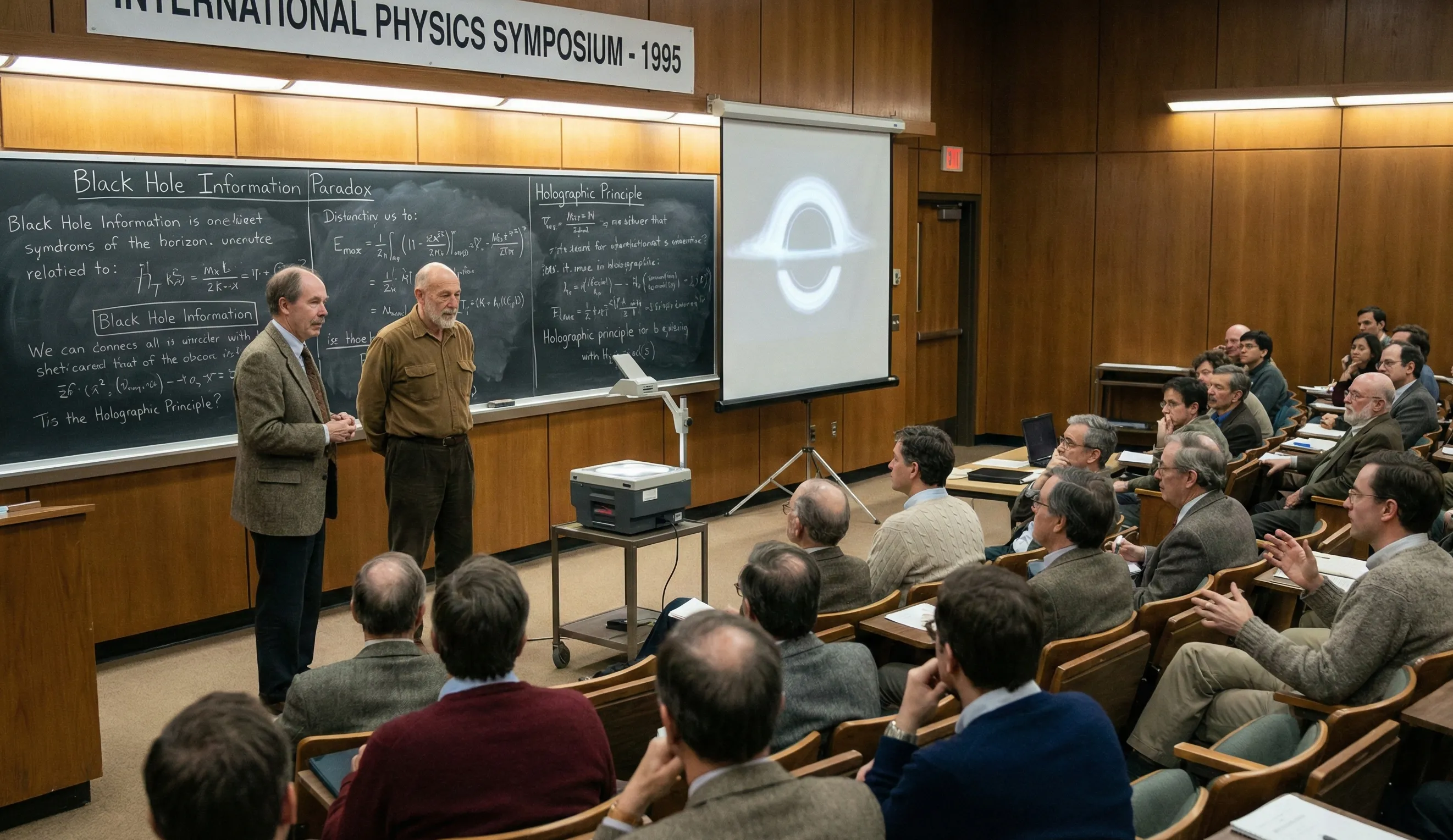
Leonard Susskind developed the idea further. In 1994, he showed how the holographic principle could resolve the information paradox. Information is not lost in black holes. It is stored on the event horizon, spread across the surface.
The idea seemed abstract, even fantastical. How could the rich three dimensional world we experience be a projection from a two dimensional boundary?
But the mathematics kept working. And in 1997, a young physicist named Juan Maldacena made a discovery that would transform the speculation into concrete physics.
Related Articles