Content Disclaimer: This article contains speculative theories presented for entertainment. Readers are encouraged to form their own conclusions.
What time is it right now? What day is today? How long is a human life?
These questions define how we measure time. How we attempt to understand it. How we try to control it.
We see time as linear. A beginning. An end. A straight line.
But this is not how our ancestors understood it.
For thousands of years, humanity lived in harmony with natural cycles. Sunrise and sunset. Seasons. Lunar phases.
Time was not a race. It was a rhythm.
And then, everything changed.
The Sumerian Method
5000 BCE. Sumer. Mesopotamia.
The first civilization to systematize time.
They divided the day into three parts. Sunrise. Noon. Sunset.
These were not arbitrary divisions. They were markers. For prayer. For work. For rest.
At night, the moon became the timekeeper. Its phases. Its cycles. Its predictability.
The lunar calendar was born.
29 or 30 days per month. Twelve months per year. Aligned with the moon's orbit.
Farmers used it. The full moon meant fertile planting. Sailors used it. The tides obeyed the moon.
Priests used it. Rituals aligned with lunar cycles.
Time was not linear. It was cyclical.
The Egyptian System
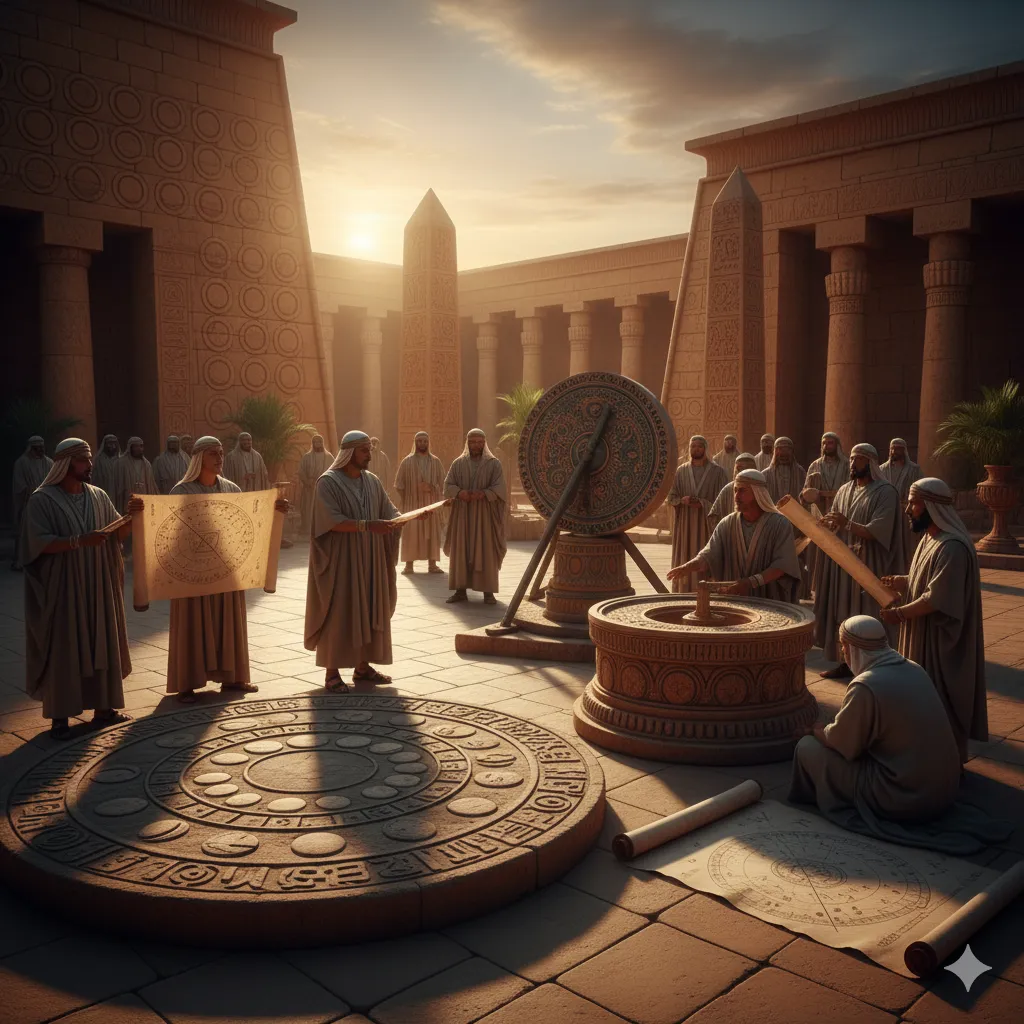
Ancient Egypt. The Nile civilization.
Their entire existence depended on the river. Its floods. Its cycles.
They observed the sun. Its angles at dawn and dusk. Its path across the sky.
They calculated the solar year. 365 days. Twelve months.
They divided daylight into twelve equal parts. The origin of the twelve-hour system.
Why twelve? Because of the Sumerian belief in twelve great Anunnaki gods. Twelve zodiac constellations.
Mathematically, twelve fit perfectly into the Babylonian base-60 system.
The Babylonians took it further. Divided one hour into 60 minutes. One minute into 60 seconds.
The system we still use today.
But here is the critical point: These systems were tools. Not philosophies.
Ancient civilizations did not see time as linear. They saw it as cyclical.
Birth. Growth. Death. Rebirth.
Nature's eternal rhythm.
The Sacred Seven
Babylon. Obsessed with astronomy.
They observed seven celestial bodies. Sun. Moon. Mars. Mercury. Jupiter. Venus. Saturn.
Each was sacred. Each represented a god.
They divided the week into seven days. Each day named after a celestial deity.
The number seven was holy. In Sumerian belief. In Jewish tradition. In Christian scripture.
And thus, the seven-day week was born.
But again, this was not linear time. This was cyclical. The week repeated. Forever.
The Cyclic Worldview
Look at ancient religions. Ancient philosophies.
Hinduism. Samsara. The cycle of birth, death, and rebirth.
Buddhism. The wheel of dharma. Endless cycles of existence.
Egyptian mythology. The sun god Ra. Dying each night. Reborn each dawn.
Greek philosophy. The eternal return. Nietzsche would later revive this concept.
Even in Christianity. The resurrection. Life after death. The eternal cycle.
None of these traditions saw time as a straight line.
They saw it as a circle. A spiral. A rhythm.
And they lived accordingly.
No rush. No anxiety. No fear of time running out.
Because time did not run out. It simply repeated.
This is the ancient understanding. The forgotten wisdom.
Time is not a race. It is a dance.
And we have forgotten how to dance.
Related Articles