Content Disclaimer: This article contains speculative theories presented for entertainment. Readers are encouraged to form their own conclusions.
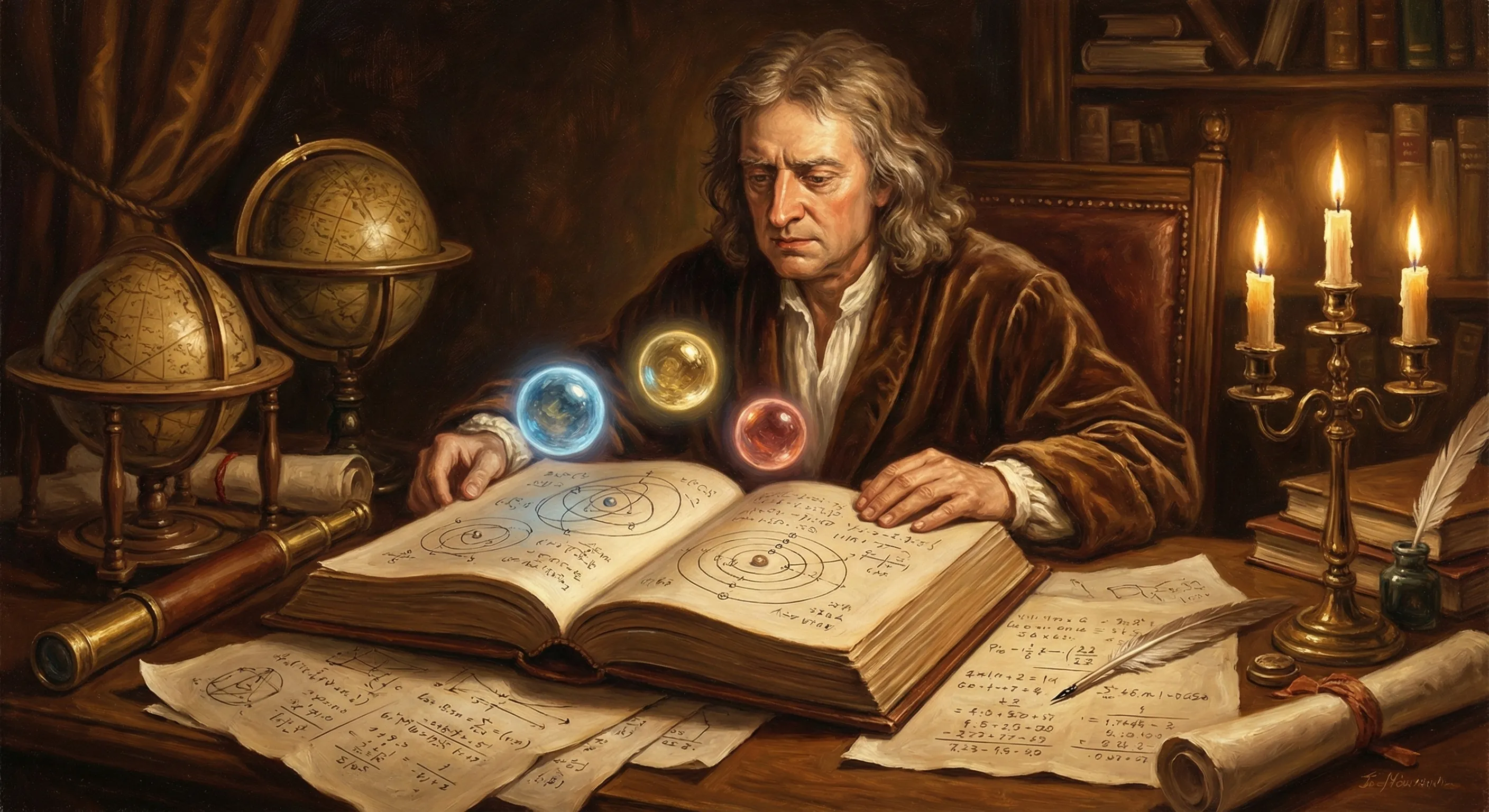
In 1687, Isaac Newton published his Principia Mathematica. The book changed everything. Suddenly, the motion of celestial bodies could be calculated with mathematical precision. The same laws that governed falling apples also governed orbiting planets.
Newton solved the two-body problem elegantly. Given two objects attracting each other through gravity, their motions could be predicted perfectly, forever. The equations were beautiful. Closed form solutions existed. The future was knowable.
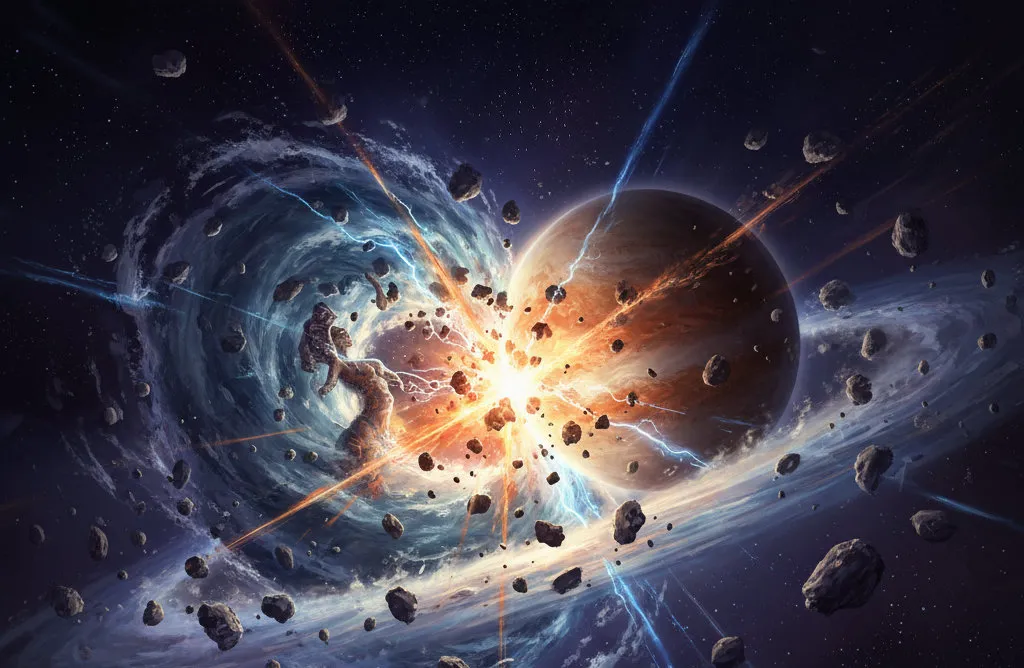
Then Newton tried to add a third body.
The mathematics collapsed into chaos.
With three objects pulling on each other, no simple solution existed. The equations became intractable. Every attempt to find a general formula failed. Newton himself admitted defeat on this problem.
For two centuries, the greatest mathematicians in Europe wrestled with the three-body problem. Euler worked on it. Lagrange found special cases. Laplace made progress on approximations. But a complete solution remained elusive.
The prize offered by King Oscar II of Sweden in 1887 brought the problem to a new generation. Solve the three-body problem, the king proclaimed, and earn immortality.
Henri Poincare took up the challenge. He was perhaps the greatest mathematician of his era, a man who could see patterns others missed. Surely he would crack what Newton could not.
Poincare worked for two years. His submission to the prize committee was brilliant, a masterwork of mathematical reasoning. He was awarded the prize in 1889. His paper was prepared for publication.
Then Poincare discovered an error in his own work.
The error was not trivial. In correcting it, Poincare stumbled onto something that would change mathematics forever. He discovered that the three-body problem was not just difficult. It was fundamentally different from the two-body problem.
Small changes in initial conditions produced wildly different outcomes. The system was deterministic but unpredictable. Cause and effect held, but the future could not be computed. The universe obeyed exact laws, yet remained unknowable.
Poincare had discovered chaos.
Not chaos in the colloquial sense of randomness or disorder. Mathematical chaos. A universe where perfect knowledge of the present still could not reveal the future. Where prediction had fundamental limits built into the fabric of reality itself.
The three-body problem was not waiting for a smarter mathematician to solve it. It was unsolvable in principle. Not because our mathematics was weak, but because the universe itself contained irreducible complexity.
Newton's clockwork cosmos had cracks in it.
Related Articles