Content Disclaimer: This article contains speculative theories presented for entertainment. Readers are encouraged to form their own conclusions.
July 25, 1976. A NASA scientist sat reviewing photographs from Mars. The Viking 1 orbiter had been transmitting images for weeks, documenting craters and mesas across the Cydonia region. Frame after frame showed familiar Martian terrain.
Then frame 35A72 arrived.
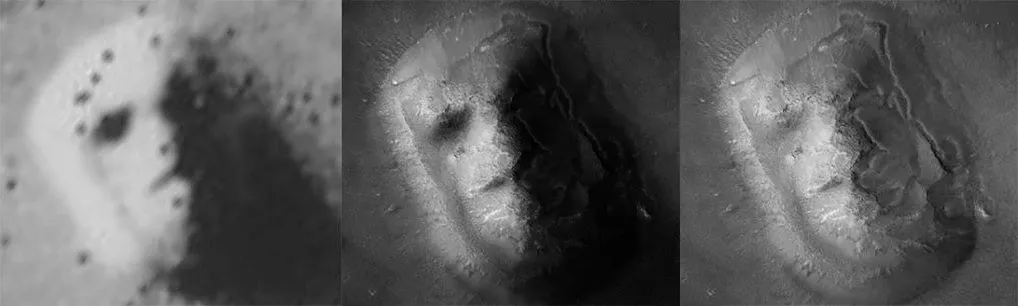
The scientist enlarged the image, assuming an error in transmission. But the structure remained. A formation 1.5 kilometers wide, 225 million kilometers from Earth, bearing unmistakable resemblance to a human face. Two eye sockets. A nose. A mouth. Symmetrical features carved into the Martian surface.
The next day, NASA held a press conference. Every journalist asked the same question. What was this face, and who made it?
NASA's response was swift. The image was an optical illusion, they explained. A trick of light and shadow. A second photograph taken shortly after showed the formation looked nothing like a face.
There was only one problem. The second photograph did not exist. NASA had invented it to end the conversation.
The fascination with Mars runs deep in human history. Ancient Egyptians saw it as a god. Greeks named it for their deity of war. In 1877, Italian astronomer Giovanni Schiaparelli observed what he called canali on the Martian surface. The press translated this as canals, implying artificial construction. The idea of Martian civilization entered popular imagination and never left.
When the Mariner 4 spacecraft flew past Mars in 1965, returning twenty two photographs, the world watched with anticipation. What cities would we find? What ruins of ancient builders?
The images showed only craters. A barren world, cratered like the Moon. Disappointment spread through both the scientific community and the public imagination. Mars appeared dead.
But appearances can deceive. We now know Mars once had oceans. Rivers carved its surface. Volcanoes warmed its atmosphere. A magnetic field protected it from solar radiation. The red planet was once blue.
If life arose there, what traces might remain? And if intelligence evolved, what monuments might it have left behind?
In 1976, Viking gave us our first close look at a region that would become the most controversial terrain in planetary science.
Related Articles