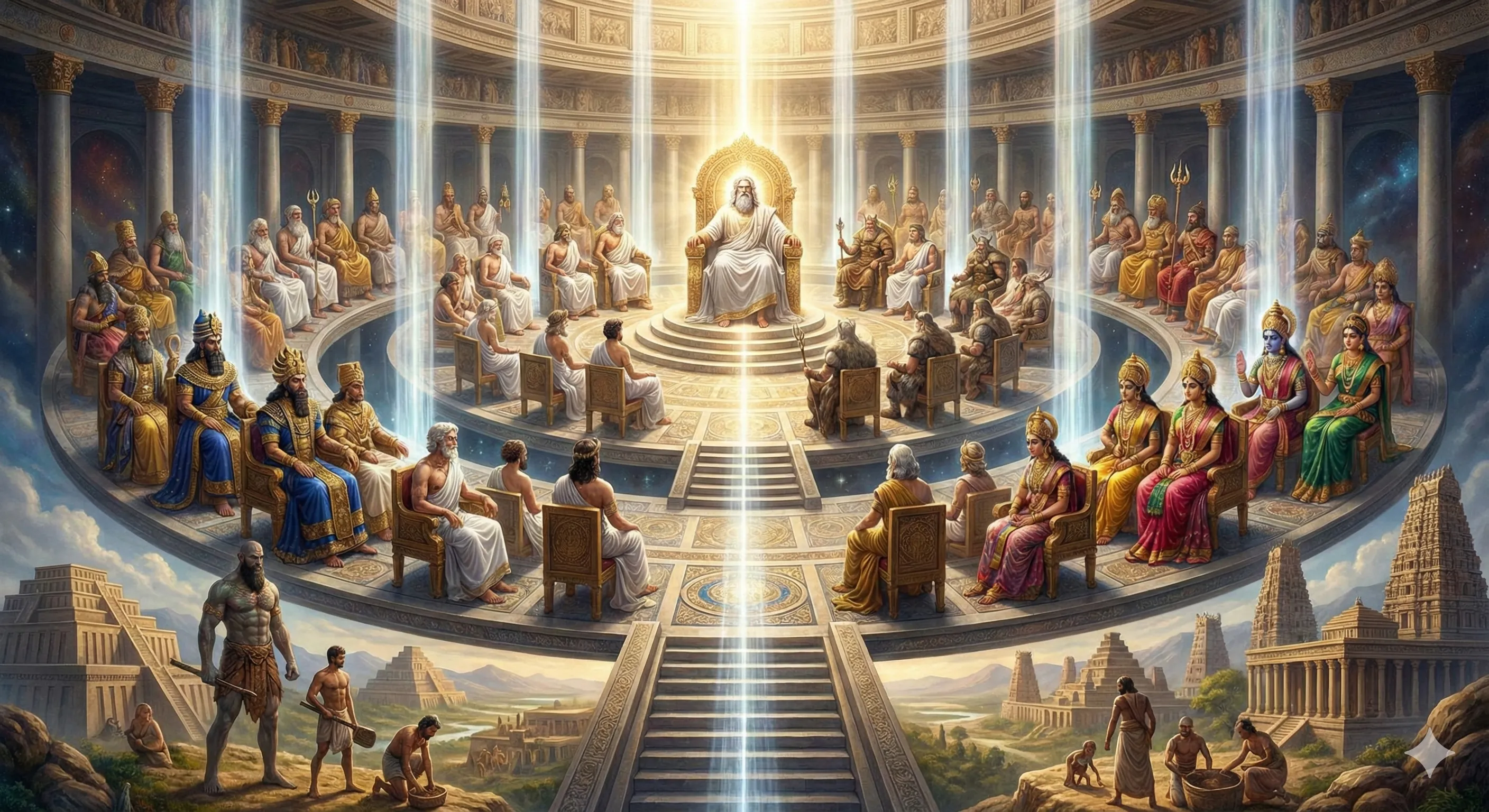
The Hierarchy That Spans All Mythologies
Gods, Angels & Anunnaki: Common Threads
Exo-PoliticsContent Disclaimer: This article contains speculative theories presented for entertainment. Readers are encouraged to form their own conclusions.
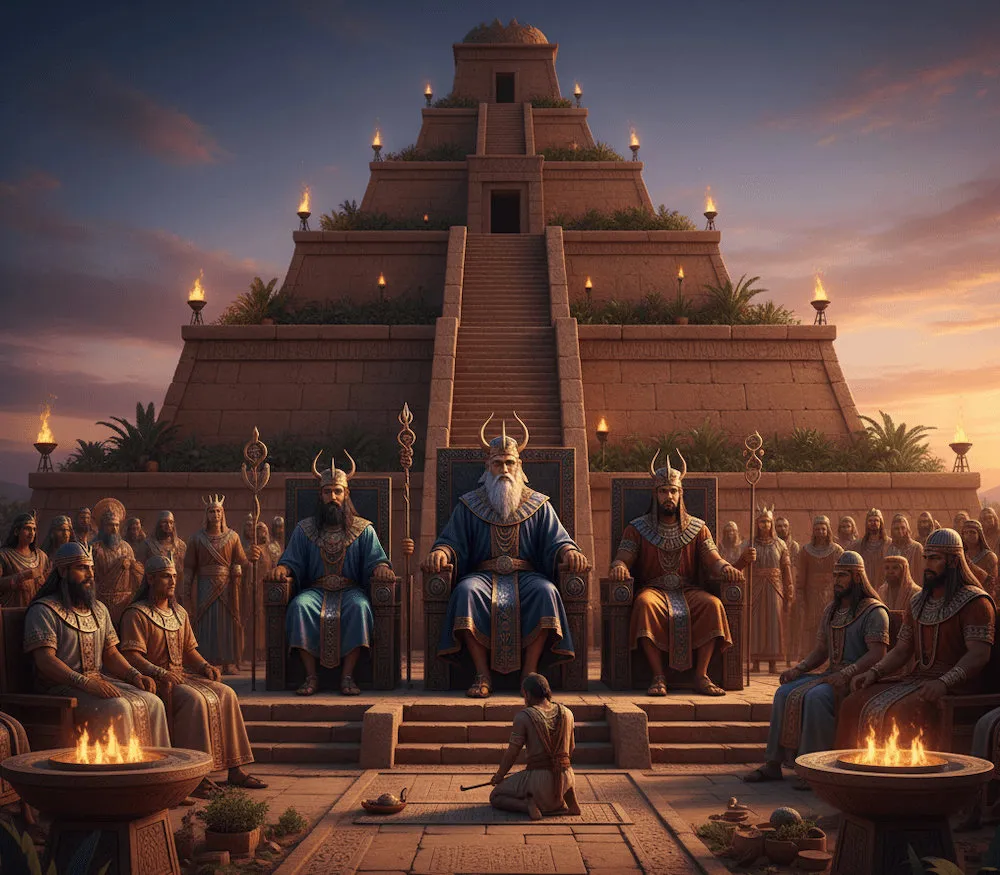
Every ancient civilization described the same structure. A council of gods. A chief deity at the top. Subordinate gods below. Messengers connecting heaven and earth. Humans at the bottom. The names changed. The hierarchy remained.
In Sumer, they were the Anunnaki. Fifty great gods, led by Anu, the sky father. Below him, the seven who decree fate: Enlil, Enki, Ninhursag, Inanna, Utu, Nanna and Ereshkigal. Then the Igigi, the younger gods who served. Then humans, created to labor.
In Canaan, they were the Elohim. El, the father god, presided over the divine council. His sons were assigned nations. Yahweh received Israel. Baal received Canaan. The structure was not monotheistic. Psalm 82 records it explicitly: "God presides in the great assembly; he renders judgment among the gods."
In Greece, the Olympians. Zeus at the top. Twelve principal gods. Hundreds of lesser deities, nymphs, spirits. Heroes born from god-human unions. Mortals at the base. The hierarchy mirrored Sumerian structure so precisely it suggests inheritance, not coincidence.
In Hindu cosmology, the Devas. Brahma, Vishnu, Shiva as the trinity. Below them, the minor gods. Below them, the Asuras, the rebellious gods. Below them, humans. The structure is fractal: councils within councils, hierarchies within hierarchies.
In Norse mythology, the Æsir and Vanir. Odin, the all-father. Thor, Loki, Freya and the others. A divine council at Asgard. Humans in Midgard. The dead in Hel. Again, the hierarchy.
The pattern is too consistent to dismiss as convergent evolution of myth. Either every culture independently arrived at the same political structure for their gods, or they inherited a shared memory of an actual hierarchy. Not abstract divinity, but organized authority.
The texts describe these beings with physical specificity. They ate. They drank. They fought. They mated with humans. The Greek gods required ambrosia. The Norse gods required golden apples to avoid aging. The Sumerian gods required food and drink offerings. These are not transcendent spirits. These are beings with biological needs.
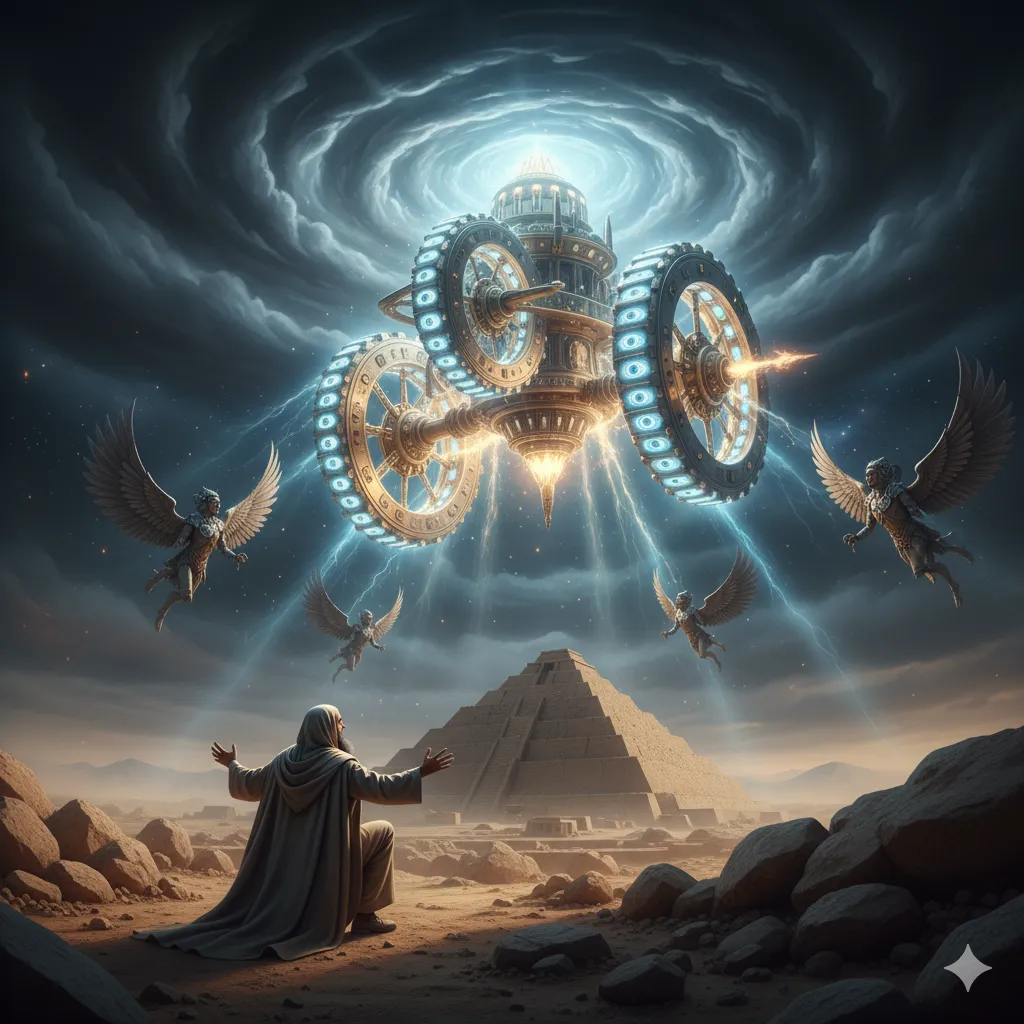
The Angels in Abrahamic tradition serve the same function as the Igigi in Sumerian tradition. Messengers. Intermediaries. Servants of the higher gods. The word "angel" derives from Greek "angelos," meaning messenger. They are not a separate category. They are the lower tier of the divine hierarchy.
Genesis 6 describes the Nephilim, offspring of "sons of God" and "daughters of men." These are not metaphorical unions. The text is explicit. Divine beings mated with humans, producing hybrid offspring. These giants were heroes of old, men of renown. The same story appears in Greek mythology: demigods, born of god and mortal, with superhuman abilities.
The Watchers in the Book of Enoch expand this narrative. Two hundred angels descended to Mount Hermon, led by Shemhazai. They took human wives. Taught humans forbidden knowledge: metallurgy, cosmetics, astrology, weaponry. Their offspring were the Nephilim, giants who consumed everything and turned to violence.
God's response was the flood. To eliminate the hybrid population. To reset humanity. The narrative parallels the Sumerian account of the flood, where Enlil sought to destroy noisy humans and their corruption. The same event, described in different texts, with the same motive: eliminate the contaminated bloodline.
The "sons of God" in Genesis are the same category as the Anunnaki in Sumer and the Elohim in Canaan. They are not abstract spirits. They are members of the divine council, subordinate gods, capable of physical interaction with humans. The hierarchy is organizational. The distinctions are rank, not essence.
The Sumerian King List records that before the flood, kings reigned for thousands of years. After the flood, lifespans dropped dramatically. The same pattern appears in Genesis. Pre-flood patriarchs lived 900 years. Post-flood lifespans decline to 120. This suggests a genetic change. Something in the pre-flood population extended lifespan. Something in the post-flood population did not.
If the Nephilim were hybrids, part divine and part human, their genetics may have conferred longevity. The flood eliminated them. The genetic trait was lost. Humanity reverted to shorter lifespans. The narrative encodes genetic history in mythological language.
The common thread across all mythologies is the council. The gods do not act alone. They convene. They debate. They vote. This is not omnipotence. This is bureaucracy. Omnipotent beings do not need councils. They act unilaterally. The gods of ancient texts are powerful, but constrained. They operate within systems. They follow rules. They answer to higher authority.
Even Yahweh, who becomes the sole God in later Jewish theology, operates within a council in earlier texts. Psalm 82, Psalm 89, 1 Kings 22, Job 1-all depict Yahweh in the divine assembly, surrounded by other gods or sons of God. Later theology reinterpreted these as angels. But the original texts use "elohim," gods, not "mal'akhim," angels.
The names of the Anunnaki parallel the names of Hebrew angels. Enlil and El. Enki and Elohim. Inanna and the female aspects of divinity suppressed in later texts. The linguistic connections are more than coincidental. They are derivatives. Later cultures inherited the names and adapted them to their theology.
The tower of Babel narrative encodes this inheritance. Humanity spoke one language. They built a tower to reach heaven. God-plural in the Hebrew, "let us go down"-confused their language and scattered them. The story explains cultural divergence. But it also preserves the memory of linguistic unity. Of a time when all people shared the same words, the same names for the gods, the same understanding of the hierarchy.
The Anunnaki were not unique to Sumer. They were the original council. Other cultures adopted and renamed them. The structure persisted because it described something real. Not metaphysical divinity, but an organized group of advanced beings who interacted with early humans, established hierarchies, and left records that were gradually mythologized.
The gods, angels and Anunnaki are the same category seen through different cultural lenses. The hierarchy is consistent because it described an actual chain of command. The names changed. The roles remained. And the memory of their presence endures in every tradition that followed.
Related Articles