Content Disclaimer: This article contains speculative theories presented for entertainment. Readers are encouraged to form their own conclusions.
In the 6th century BCE, during the Babylonian exile, a priest named Ezekiel walked along the banks of the Chebar River. What he saw that day would become one of the most debated passages in religious history.
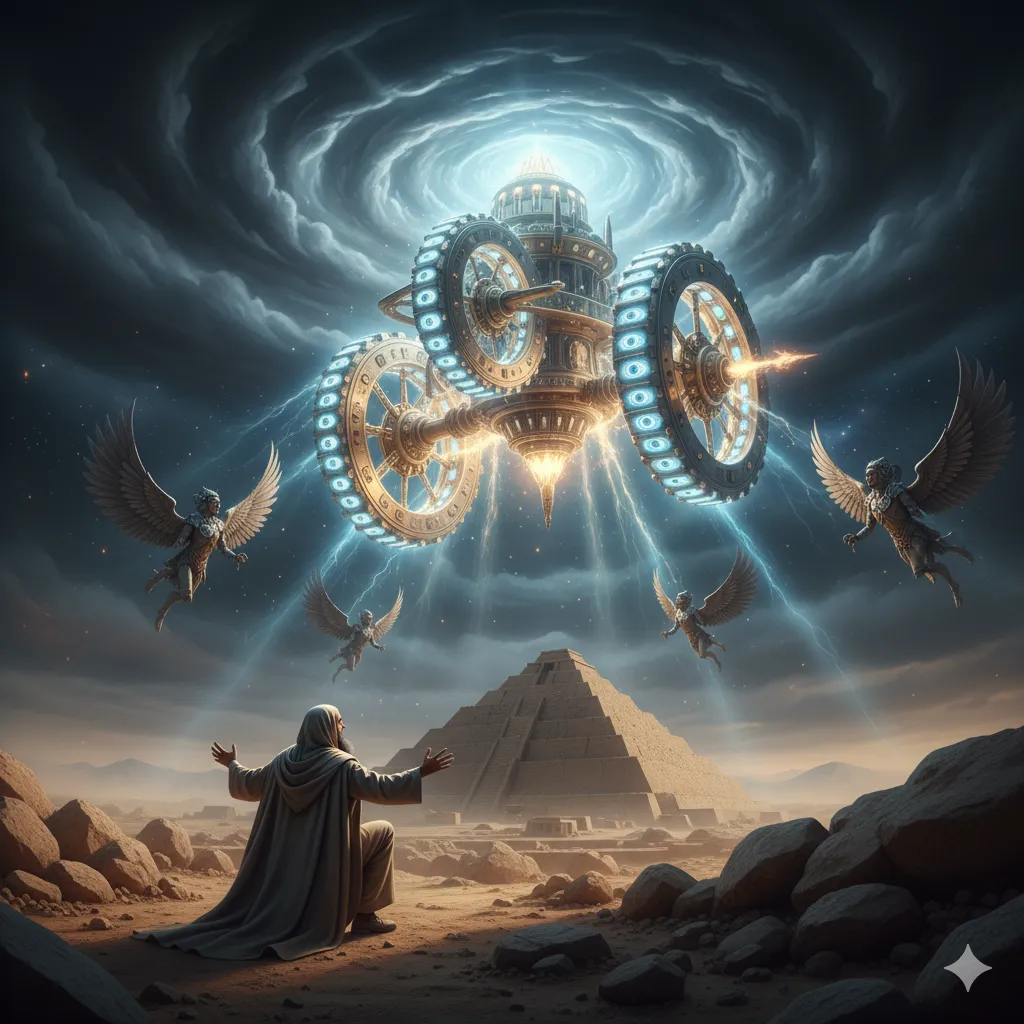
According to the text, a storm cloud approached from the north. But this was not an ordinary storm. It moved with purpose, glowing from within, surrounded by fire. Ezekiel described it as containing something that looked like polished bronze in the center of the flames.
As the object drew closer, four living creatures emerged. They had human-like forms but were not human. Each had four faces: human, lion, ox, and eagle. Each had four wings. Their legs were straight, and their feet resembled burnished bronze. Beneath their wings, they had human-like hands.
These beings, which Ezekiel called cherubim, were not alone. Beside each of them was a wheel. And the wheels were unlike anything he had seen before.
The wheels gleamed like chrysolite. They appeared to be constructed with one wheel intersecting another, forming a structure that could move in any direction without turning. The rims were tall and covered with eyes. And wherever the cherubim moved, the wheels moved with them, as though the spirit of the living creatures was in the wheels.
Above the heads of the cherubim was something resembling a crystal dome. And above the dome was a throne made of what looked like sapphire. Seated on the throne was a figure that appeared human but radiated light and fire.
Ezekiel fell to his face. A voice spoke to him. It told him he had been chosen to carry a message to the rebellious house of Israel. And then, the vision intensified.
The spirit lifted him up. He described being taken between earth and sky, transported in an instant from the river to Jerusalem. He saw things hidden from mortal eyes. The inner chambers of the temple. The corruption of the priests. The abominations committed in secret.
When the vision ended, he found himself back at the river, physically and mentally exhausted. He did not speak for seven days.
Ezekiel's account is not unique. Across ancient texts, prophets and holy men describe being taken into the sky by divine chariots. Enoch was lifted by a whirlwind and passed through walls of fire. Elijah ascended in a chariot of fire pulled by horses of flame. Moses encountered a burning presence on Mount Sinai. Muhammad was carried on a winged creature to the heavens.
Different cultures. Different eras. But the same core elements: glowing objects, beings of light, rapid transportation, and knowledge granted from above.
Traditional interpretation calls these spiritual experiences. Visions. Metaphors for divine encounter. But Ezekiel's description is precise. Technical. He describes the mechanics of what he saw in a way that does not fit the language of metaphor.
He specifies materials: bronze, crystal, sapphire. He details movement: wheels that do not turn but move in all directions. He notes structural features: intersecting rings, domed surfaces, luminous beings with articulated limbs.
If Ezekiel were describing a vision, why include such specificity? Why describe the engineering of the wheels? Why mention that the cherubim had hands beneath their wings, or that their legs were straight?
Unless he was not describing a vision. Unless he was describing what he actually saw. A craft. Beings. Technology so advanced it could only be interpreted through the lens of the divine.
In the 20th century, aerospace engineer Josef Blumrich read Ezekiel's account and was skeptical. He intended to debunk it. Instead, after analyzing the text, he concluded that Ezekiel had described a functional spacecraft. Blumrich published his findings in a book titled "The Spaceships of Ezekiel," complete with technical diagrams reconstructing the craft based on the prophet's words.
Whether one accepts Blumrich's conclusions or not, the question remains: what did Ezekiel see? And why does his description align so closely with modern reports of unidentified aerial phenomena?
The cherubim, with their multiple faces and mechanical precision, resemble descriptions of advanced robotics or artificial intelligence. The wheels within wheels evoke gyroscopic stabilization systems. The ability to move in any direction without turning matches omnidirectional propulsion, technology only recently developed by human engineers.
Ezekiel's vision was not an isolated event. It was part of a pattern. A pattern of contact between humanity and something from beyond. Something that appeared in the skies, interacted with select individuals, and left behind accounts that transcend culture and time.
The ancients called them gods. Messengers. Angels. Chariots of fire.
We call them UAPs. Unidentified Aerial Phenomena. And after thousands of years, we are still asking the same question Ezekiel must have asked as he stood by the river, watching the storm cloud descend:
What are they? And what do they want?
Related Articles