Content Disclaimer: This article contains speculative theories presented for entertainment. Readers are encouraged to form their own conclusions.
Surveillance cameras spread through cities in waves. Every crisis pushed deployment forward. London led the charge, driven by IRA bombings that stretched from the 1970s through the 1990s.
After September 11, 2001, the expansion went global. Governments installed cameras at airports, train stations, public squares. Businesses added their own for security. Homeowners slapped them on doorsteps.
The cameras multiplied until they became invisible, just part of the background, like streetlights or mailboxes. You stop noticing them because they're everywhere.
For years, though, these cameras had a fundamental problem: someone actually had to watch the footage. A human being needed to sit in front of monitors, scanning for anything suspicious.
Thousands of hours got captured every day. Most of it never got reviewed. The cameras recorded everything but understood nothing. Blind witnesses, creating archives that mostly went unseen.
Storage became a nightmare. Videotapes filled entire rooms and warehouses. Digital storage helped but created new headaches, organization, mostly. Finding a specific incident meant you already had to know when it happened.
The haystack grew faster than anyone could search for needles. Police kept complaining that cameras helped solve crimes after the fact but didn't do much to prevent them.
That limitation started changing with advances in computer vision. Algorithms learned to detect faces. Badly at first. Then with increasing accuracy.
By the early 2010s, facial recognition could match photographs against databases containing millions of people. Reliability rates started approaching human performance.
The technology came from an unexpected place. Facebook trained its systems on billions of photos that users uploaded themselves. Every time you tagged a friend, you created training data.
Google developed image recognition through its photo services. Apple built face detection into iPhones. The same technology that tagged your friends at parties could now identify strangers on the street.
Here's the twist: commercial development of convenient features created the foundation for comprehensive surveillance.
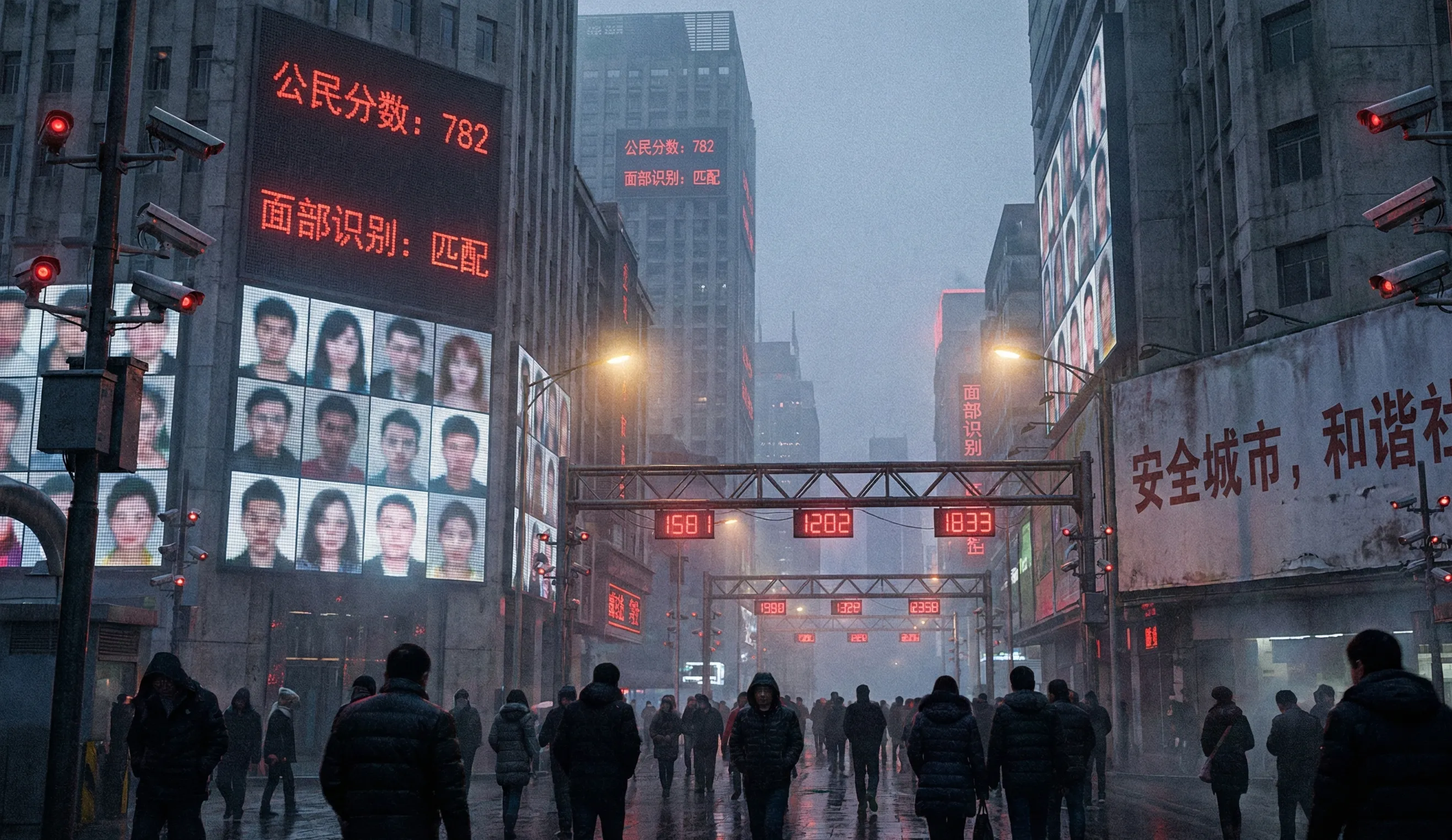
Governments adopted the tech eagerly. China deployed facial recognition across its entire surveillance network. The FBI built a database containing hundreds of millions of faces.
Police departments acquired systems capable of scanning crowds in real time. The technology trickled down from national security agencies to local law enforcement to private security firms.
The Snowden revelations of 2013 exposed digital surveillance at a massive scale. Intelligence agencies were collecting phone records, emails, browsing history from millions of people.
But that was surveillance of communications. Digital trails left through devices. This new surveillance was something different.
> Surveillance of physical presence. Where you go with your body. Who you meet in person. What you do in spaces you thought were anonymous.
Clearview AI showed just how far the technology could reach. A startup scraped billions of photographs from social media and built a database larger than any government's.
Law enforcement quietly started using it. Any photograph could be matched against this database. Not just a name, a complete online history revealed in seconds.
> The person sitting next to you on the subway could be identified. Social media accounts. Work history. Public records. Anonymity in public started dissolving.
The infrastructure of mass surveillance had been assembled piece by piece. Camera by camera. Algorithm by algorithm.
What remained was to make it truly intelligent. Not just recording and identifying, but analyzing, predicting, alerting in real time.
That transformation was already underway.
Related Articles