Content Disclaimer: This article contains speculative theories presented for entertainment. Readers are encouraged to form their own conclusions.
The experience of losing track of time is as old as human consciousness itself. Ancient texts from various civilizations contain accounts of individuals who vanished for hours, days, or even years, only to return with no memory of where they had been.
Celtic folklore speaks of travelers who stumbled into fairy rings and emerged moments later to discover decades had passed. Japanese legends tell of fishermen who visited underwater palaces and returned to find their entire village had aged beyond recognition.
> These ancient stories share a common thread: the profound disorientation of experiencing time differently than the rest of the world.
The phenomenon transcended cultural boundaries. Greek myths described mortals who visited the realm of the gods and lost all sense of temporal passage. Hindu scriptures contained accounts of meditators who entered deep states only to emerge believing minutes had passed when seasons had changed.
During the medieval period, missing time experiences were often attributed to divine intervention or demonic possession. Monks documented cases of individuals who fell into trances and awoke hours later with no recollection of the intervening time.
Saint Augustine wrote extensively about the nature of time and consciousness. He puzzled over how the mind could experience temporal gaps and what this revealed about the relationship between soul and body.
> The Church both feared and revered these experiences, uncertain whether they represented communion with the divine or corruption by darker forces.
Village records from this era contain scattered accounts of people who wandered into forests and emerged days later, emaciated and confused. They could not account for their absence and often spoke of strange lights or ethereal music.
As the scientific method emerged, scholars began approaching missing time phenomena with new tools. Rather than attributing these experiences to supernatural causes, they sought physiological explanations.
French physician Jean-Martin Charcot studied patients who exhibited unexplained memory gaps. He documented cases where individuals performed complex actions during fugue states with no subsequent recollection.
> The emerging field of psychology provided a new framework for understanding these puzzling experiences.
Hypnotism, developed during this period, offered a method for exploring hidden memories. Practitioners discovered that subjects could sometimes access lost time experiences under hypnotic suggestion, revealing elaborate narratives that had been inaccessible to conscious recall.
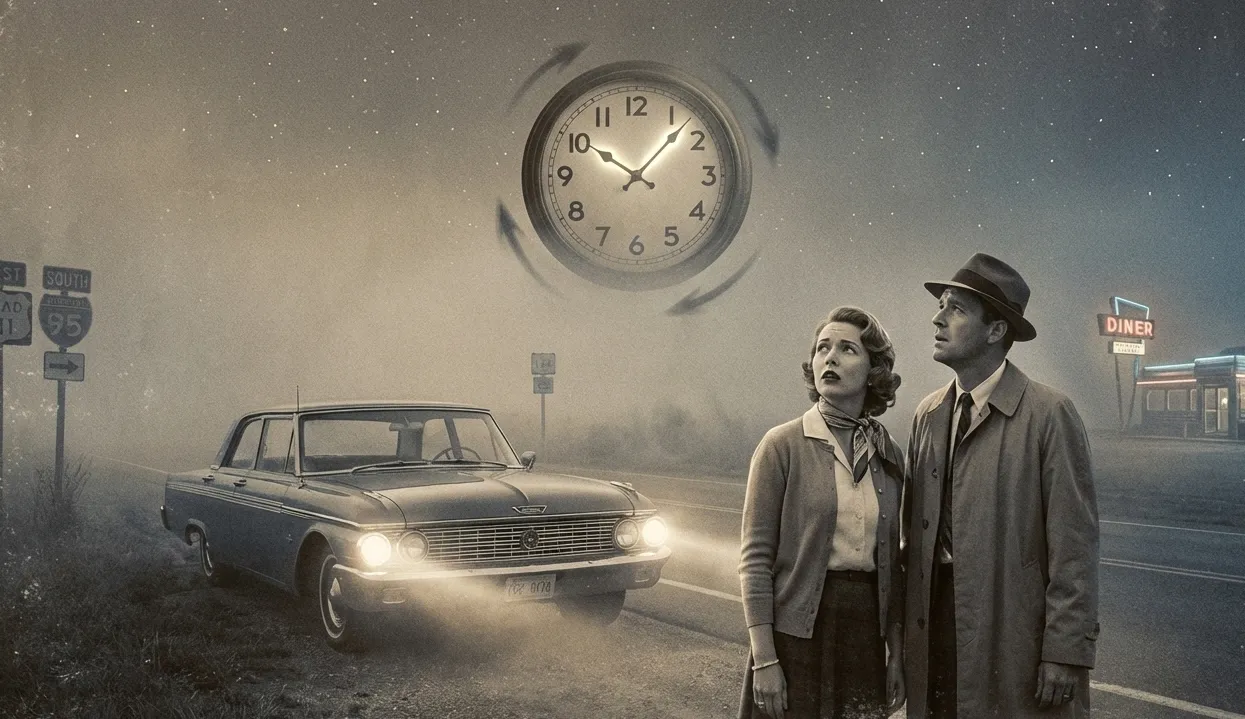
The modern era of missing time investigation began on September 19, 1961. Betty and Barney Hill were driving through rural New Hampshire when they observed a strange light in the sky.
What should have been a four-hour drive took seven hours. The couple arrived home with no memory of approximately two hours of their journey. They noticed strange marks on their car and experienced recurring nightmares.
> Their case would become the template for thousands of similar reports that followed.
Under hypnosis conducted by Dr. Benjamin Simon, both Betty and Barney independently described being taken aboard a craft and examined by non-human entities. Their accounts, while controversial, brought missing time phenomena into mainstream awareness.
Following the Hill case, researchers began systematically documenting missing time experiences. Dr. J. Allen Hynek, an astronomer who initially worked to debunk UFO reports, became convinced that something genuinely anomalous was occurring.
He coined the term "close encounters" and categorized experiences by their proximity and intensity. Missing time became a defining characteristic of what he called "close encounters of the fourth kind."
> The scientific establishment remained skeptical, but the volume of consistent reports demanded explanation.
Budd Hopkins, an artist turned researcher, interviewed hundreds of individuals who reported lost time. He noticed consistent patterns: highway driving at night, isolated locations, and subsequent physical symptoms including unusual marks and nosebleeds.
Declassified documents reveal that various government agencies took missing time reports seriously, though publicly they dismissed such accounts.
Project Blue Book, the Air Force's official UFO investigation program, documented numerous cases involving temporal anomalies. Many of these files remained classified for decades.
> The gap between public denial and private investigation suggested authorities knew more than they revealed.
International governments conducted their own inquiries. French space agency CNES created GEPAN to study anomalous aerial phenomena, and their files contained numerous missing time accounts from credible witnesses including pilots and military personnel.
By the 1980s, missing time had become inextricably linked with the abduction phenomenon. Researchers like David Jacobs and John Mack from Harvard brought academic credentials to a field often dismissed as fringe.
Dr. Mack, a Pulitzer Prize-winning psychiatrist, interviewed over 200 individuals who reported abduction experiences. He concluded that while the literal nature of their experiences remained uncertain, something profoundly real was happening to these people.
> The psychological impact on experiencers was undeniable, regardless of what ultimately caused their missing time.
Critics argued that hypnotic regression created false memories. Supporters countered that many experiencers reported missing time before any hypnosis occurred. The debate continues to this day, with neither side able to definitively prove their position.
Related Articles