They Have Been Trying to Read Your Mind for Decades
Neuralink: Who Owns Your Mind?
System AnomaliesContent Disclaimer: This article contains speculative theories presented for entertainment. Readers are encouraged to form their own conclusions.
Long before Elon Musk announced he was putting chips in human skulls, someone else had already tried.
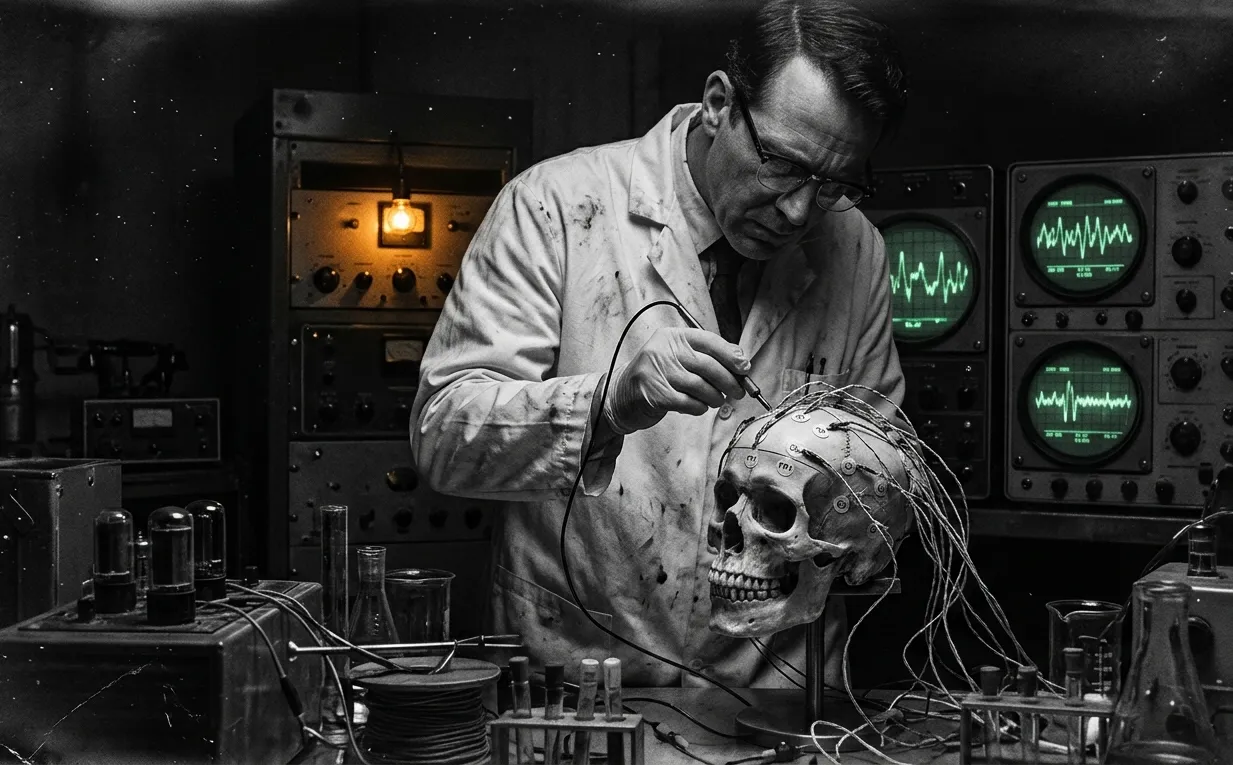
In 1924, German psychiatrist Hans Berger attached electrodes to the scalp of his son Klaus and recorded the first electroencephalogram in history. He observed rhythmic electrical waves emanating from the brain. He kept the discovery secret for five years. He was afraid no one would believe him.
He was right to be cautious. The implications were enormous. The brain was not just biology. It was electricity. It was signal. And where there is signal, there is the possibility of interception.
The military understood this immediately.
By the 1950s, the same decade the CIA was dosing unwitting subjects with LSD through MKUltra, researchers funded by defense agencies were implanting electrodes directly into the brains of animals. José Delgado at Yale became famous for stopping a charging bull in its tracks using a radio-controlled implant in its brain. He wrote a book in 1969 called "Physical Control of the Mind." He believed brain stimulation could be used to create a psychocivilized society.
Read that phrase again. Psychocivilized society.
Delgado was not a fringe figure. He was funded by the Office of Naval Research. He testified before Congress. He described a future where humans could be pacified, motivated, or controlled through direct neural stimulation. He saw this as progress.
The research went dark after that. Officially.
In the 1970s, DARPA, the US military's advanced research agency, began quietly funding neural interface programs. The goal was not therapy. It was performance. Faster pilots. Soldiers who could control weapons systems with their thoughts. Communication that bypassed the physical limitations of the human body.
The first cochlear implant, a device that turns electrical signals into auditory perception, was approved in 1984. A machine bypassing broken biology and speaking directly to the brain. Patients who had been deaf for decades heard their first sounds. The technology worked. The door was open.
By the 1990s, researchers at Brown University were doing something that seemed impossible. They were recording the firing patterns of individual neurons in monkey brains and translating that electrical activity into computer commands. A monkey could move a cursor on a screen using only its thoughts.
In 2004, a quadriplegic man named Matthew Nagle became the first human to have a neural implant that allowed him to control a computer, a television, and a robotic arm using only his mind. The implant was called BrainGate. The research behind it came from DARPA funding.
The technology was real. It had been real for longer than most people knew.
But it remained in laboratories. In clinical trials. Hidden behind technical papers and institutional ethics boards and the slow machinery of medical approval.
Then Elon Musk decided to move faster.
In 2016, he co-founded Neuralink with eight neuroscientists. His stated goal was to prevent artificial intelligence from surpassing human control. If machines were going to become smarter than humans, the only solution was to merge humans with machines. To upgrade the biological brain before the silicon one left it behind.
He called it solving the existential threat of AI.
Others called it something else entirely.
What nobody mentioned, at least not loudly, was that the infrastructure for reading and writing to the human brain had been under construction for sixty years. The cochlear implant. The retinal prosthesis. The deep brain stimulator used for Parkinson's. BrainGate. These were not isolated experiments.
They were steps.
Neuralink was not the beginning of something new. It was the moment the project finally came out of the shadows.
Related Articles