
The Birth of Secrets
The Password Conspiracy: The Hidden War for Your Digital Identity
System AnomaliesContent Disclaimer: This article contains speculative theories presented for entertainment. Readers are encouraged to form their own conclusions.
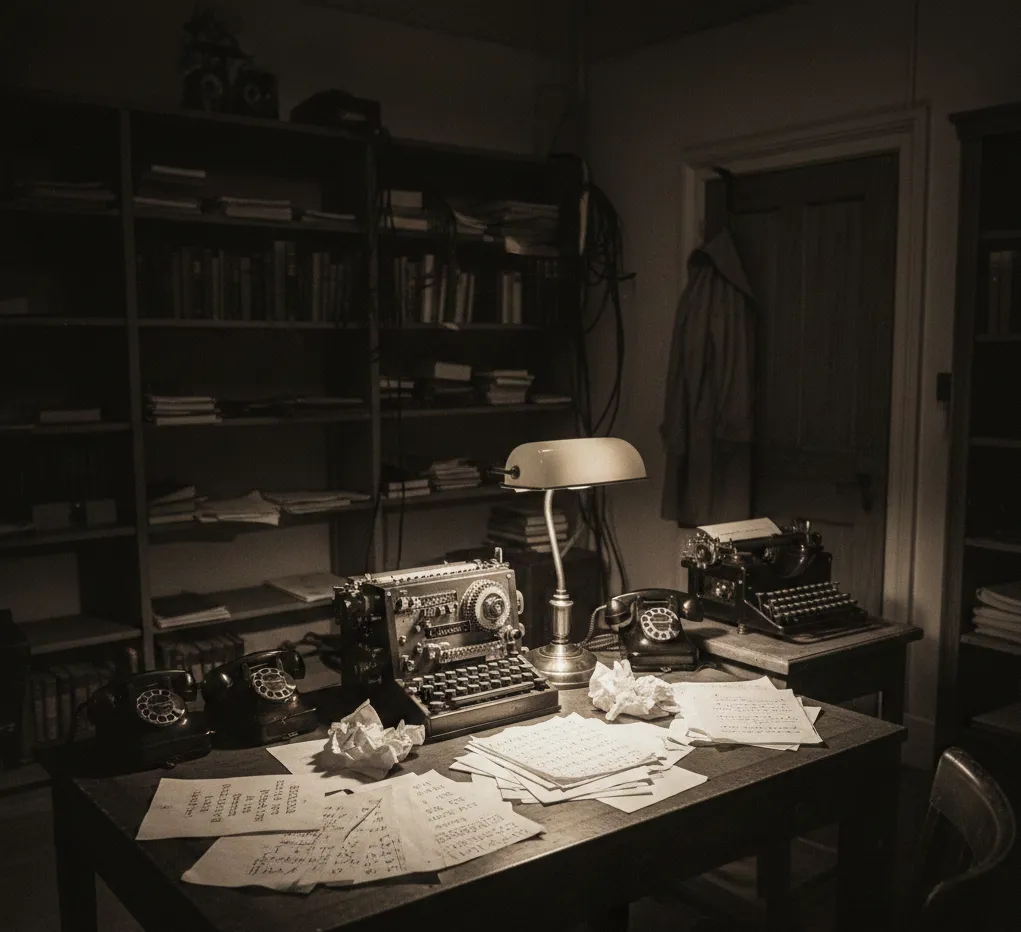
1943. Bletchley Park, a place shrouded in secrecy. There, a young mathematician, Alan Turing, wrestled with a problem that would become legendary. The Nazi Enigma machine, with its 158 quintillion possible settings, was deemed unbreakable by military minds. They were mistaken.
Turing and his colleagues didn't just solve the Enigma. They built the very groundwork for modern computing, and, without realizing it, for the digital security systems that would later touch billions of lives. When the war concluded, the British government sealed all Enigma-related work under a thirty-year classification. The stated reason? National security. The main reason was more practical: they had found something more valuable than any military secret. They had discovered the mathematics behind privacy.
The idea of a password, as we know it today, started in 1961 at the Massachusetts Institute of Technology. Fernando Corbató, a researcher, was working on the Compatible Time-Sharing System, one of the first operating systems that allowed many users to access the same computer. The main problem was simple: how could users keep their files private? His solution was simple but effective. Each user would have a secret word, known only to them. If they typed it correctly, the system would allow access. If they typed it incorrectly, they would be denied access.
This was the beginning of the first computer password.
Corbató likely never envisioned the vulnerability of his creation. Mere months after its introduction, a PhD student at MIT uncovered that the master password file was stored in an easily readable format. He printed it, distributed copies to his peers, and then had unrestricted access to all computing resources. The initial password compromise happened less than a year after passwords were first used.
This scenario would play out repeatedly, time and again. For every lock, a key would be found. For every wall, a door. The inherent weakness of the password system was evident from the start: humans are notoriously bad at keeping things secret.
By the 1970s, computer scientists were aware of the issue. Robert Morris Sr., a cryptographer at Bell Labs, came up with the idea of hashed passwords. Computers began storing passwords not as plain text, but as mathematically altered versions. Even if a file was compromised, all an attacker would see is a jumble of characters. This was a stopgap measure, buying the industry some breathing room, but it didn't address the core issue.
The human element was still the most vulnerable point.
During the 1980s and 1990s, as personal computers proliferated in homes and workplaces, password security remained surprisingly basic. Many systems permitted passwords as short as four characters. Security questions often relied on easily obtainable details, such as a mother's maiden name or a childhood pet's name. Database administrators frequently stored passwords in plain text, viewing encryption as too costly and labor-intensive.
At the same time, hackers were adapting. The term itself shifted, from a mark of distinction among inquisitive programmers to a label for those with malicious intent. Underground groups, huddled on bulletin board systems, swapped secrets on how to infiltrate computer systems. They quickly learned that social engineering often outperformed any technical hack. Why bother cracking a password when you could just ask for it?
The most notorious case surfaced in 1988. Kevin Mitnick, using a blend of technical prowess and manipulation, penetrated some of the most secure networks in the United States. He didn't rely on fancy tools. He understood people. They wanted to assist. They wanted to believe. These deeply ingrained social instincts, honed over millennia, became weaknesses in the digital world.
As the internet boomed in the late 1990s, the password problem grew exponentially. Every website, every service, every platform seemed to require its own account. Users were left juggling dozens, then hundreds, of unique login details. The human brain, remarkable as it is, just wasn't built for this kind of thing.
The outcome was hardly surprising. People opted for easy passwords. They recycled the same ones across different sites. They scribbled passwords on sticky notes and stuck them to their screens. They shared accounts with family and friends. What every security expert dreaded became the norm.
The seeds of modern solutions like NordPass were planted in this chaotic era. The vision was clear: if humans couldn't remember hundreds of unique passwords, perhaps technology should do it for them.

Don't wait for the next big breach to take action. Whether you're at home, at work, or traveling the world, the tools to protect yourself are already here. NordPass keeps your passwords encrypted and organized. NordVPN lets you browse privately from anywhere in the world. And Saily keeps you connected globally with secure eSIM technology. The future of digital security isn't coming, it's already here.
Related Articles



📋 Affiliate Disclosure
This article contains affiliate links. If you purchase a product or service through these links, we may earn a commission at no additional cost to you. We only recommend products we genuinely believe provide value to our readers. Our editorial content is not influenced by affiliate partnerships, and all opinions expressed are our own.