Content Disclaimer: This article contains speculative theories presented for entertainment. Readers are encouraged to form their own conclusions.
The year was 1968. Humanity prepared to walk on the Moon. The Cold War defined global politics. Technology promised unlimited progress. While the world looked toward infinite space, one scientist looked inward.
John Calhoun built a paradise for mice.
Born in Tennessee in 1917, Calhoun had spent decades studying animal behavior and population dynamics. He watched postwar America explode with growth. Factories churned out products. Suburbs sprawled across the landscape. Consumption became culture. Population soared.
Calhoun saw a problem others ignored. Resources were finite. Space was limited. What happens when a population grows beyond its environment's capacity to provide meaning, not just sustenance?
He decided to find out.
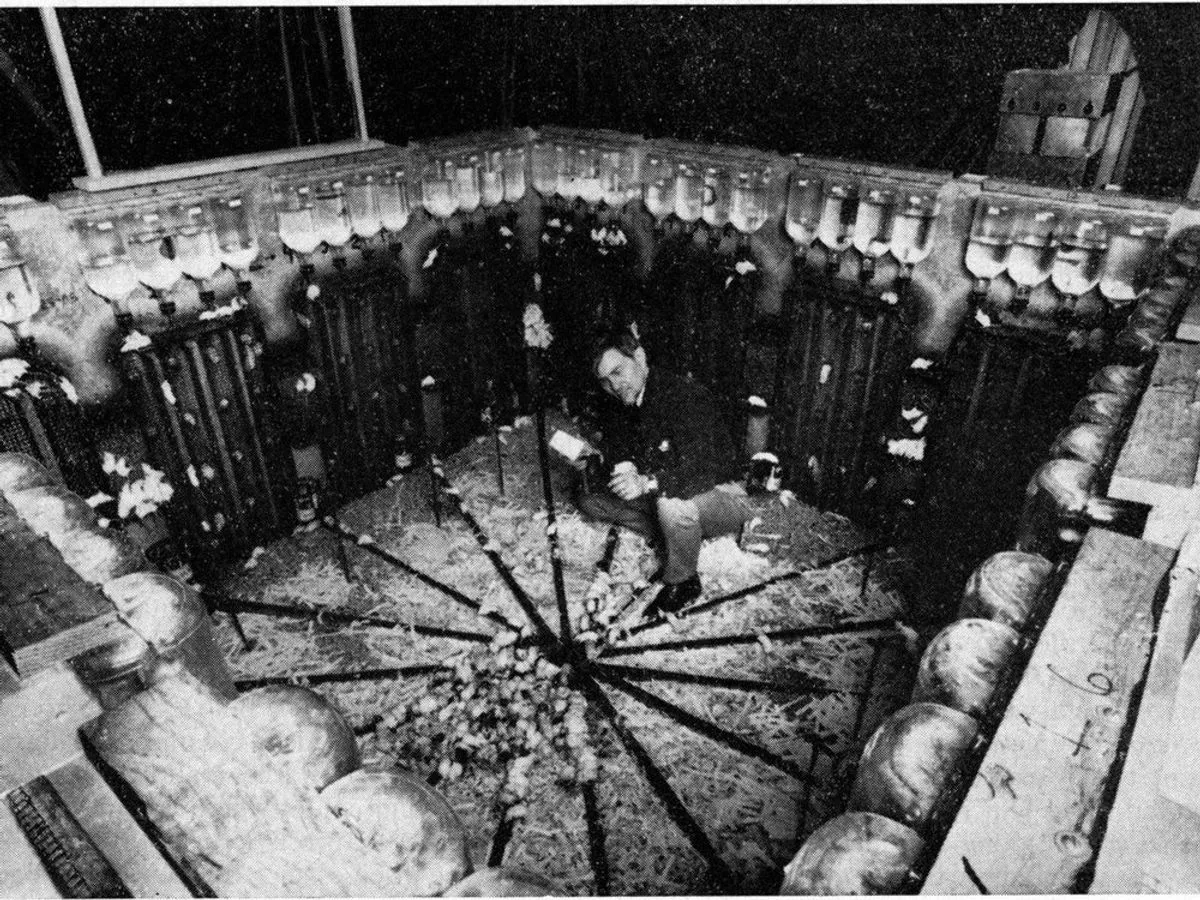
His first experiment began in 1947 on borrowed land near Johns Hopkins University. He constructed a quarter acre enclosure and called it Mouse City. Food was unlimited. Water flowed freely. Predators were absent. Safety was guaranteed.
He introduced five breeding pairs and calculated the space could support five thousand mice. He waited to see what would happen.
The population grew but plateaued at one hundred fifty. It never approached the theoretical maximum. Mice clustered in groups of roughly twelve, leaving vast areas of the enclosure empty. They chose social density over spatial freedom.
More disturbing was the infant mortality. Despite abundant resources, mothers stopped caring for their young. Pups died not from starvation or disease but from neglect. Something in the social structure was breaking.
Calhoun could not explain what he observed. But he knew he had glimpsed something important about the relationship between density, behavior, and collapse.
He continued experimenting. He refined his methods. He built more sophisticated enclosures with multiple compartments connected by passages. He documented everything.
In the rectangular habitats, patterns emerged. Dominant males established territories. Subordinate males retreated into passivity. Some became hypersexual, attempting to mate with anything regardless of gender or receptivity. Others withdrew completely, eating and grooming but showing no interest in reproduction or social interaction.
Females exhibited their own disturbances. Maternal behavior deteriorated. Nest building became careless. Aggression increased. Some mothers attacked their own offspring.
Calhoun coined a term for what he witnessed. He called it the behavioral sink. A condition where social pathology spreads through a population like contagion, even when physical needs are met.
Twenty four experiments taught him what he needed to know. In 1968, he was ready for the final test. Universe 25 would answer the question that haunted him.
What happens to a society that has everything except purpose?
Related Articles