Content Disclaimer: This article contains speculative theories presented for entertainment. Readers are encouraged to form their own conclusions.
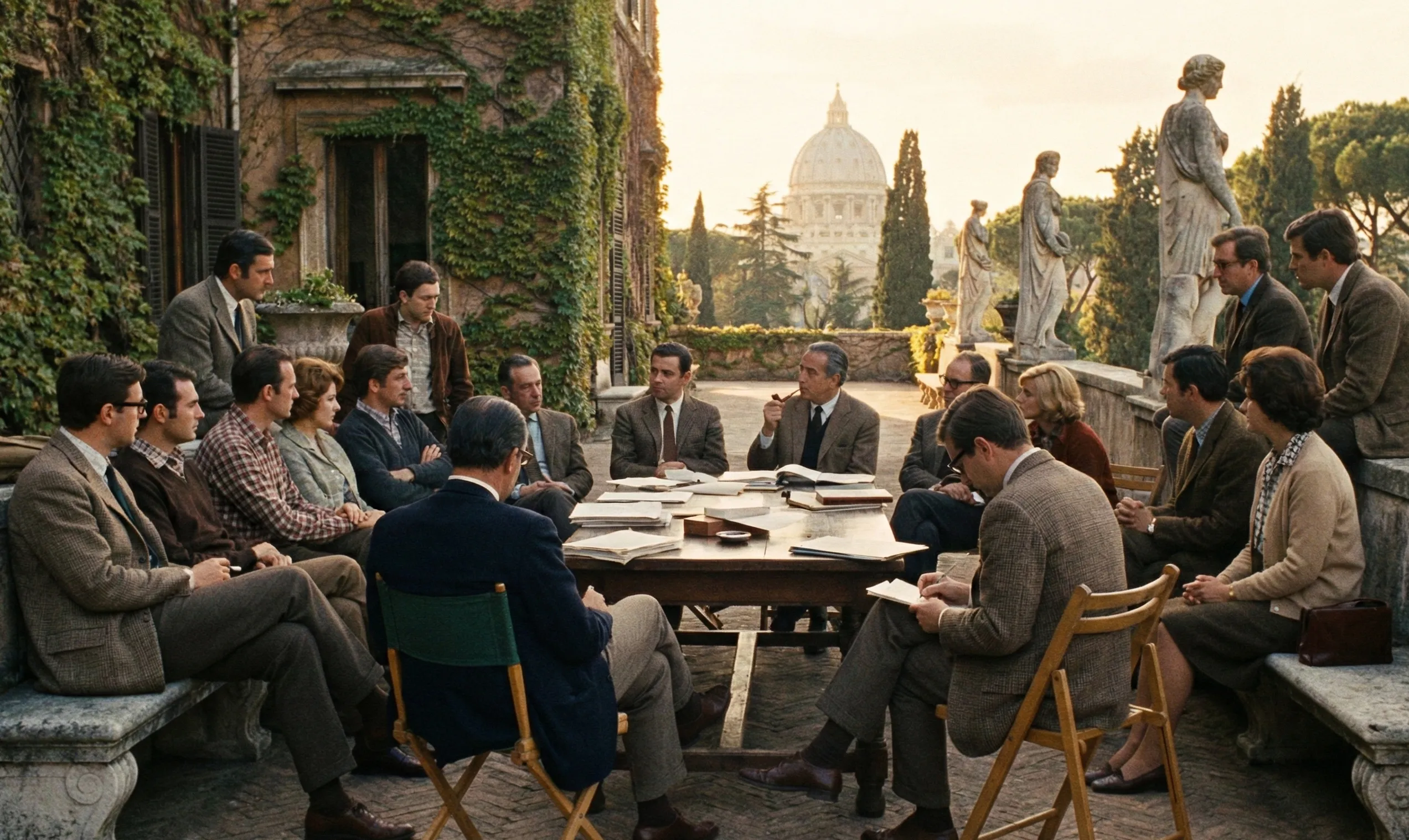
In April 1968, a small group of scientists, economists, and business leaders gathered at a villa in Rome. Italian industrialist Aurelio Peccei and Scottish scientist Alexander King had convened this meeting to discuss what they called the world problematique: the interconnected challenges facing humanity.
The timing was significant. Student protests erupted across Europe and America. Environmental concerns were entering mainstream consciousness. The post war economic boom showed signs of strain. Something fundamental seemed to be changing.
> The founders of the Club of Rome sensed that existing institutions were failing to grasp the scale and interconnection of global challenges.
Peccei brought an unusual combination of experiences. He had worked in industry, resisted fascism during World War II, and developed a global perspective through international business. He saw problems that national governments and traditional institutions seemed unable to address.
King contributed scientific credentials and connections to the OECD. His background in research policy gave him insight into how knowledge could influence decisions. Together, Peccei and King assembled a network of thinkers concerned with long term global issues.
The organization they created was deliberately informal. The Club of Rome would have no headquarters, no bureaucracy, and no official power. It would function as a network of concerned individuals who would commission research and advocate for attention to planetary challenges.
> The founders believed that moral authority rather than formal power offered the best path to influence on global issues.
Initial membership was limited to about 100 individuals from various countries and disciplines. Scientists, economists, humanists, and business leaders joined. The common thread was concern with systemic global problems and frustration with fragmented responses.
The Club's early discussions focused on population growth, resource depletion, environmental degradation, and the inadequacy of existing governance structures. These themes would define the organization's agenda for decades.
In 1970, the Club commissioned a project that would make its name famous. A team at MIT led by Dennis Meadows would model global dynamics using system dynamics methodology developed by Jay Forrester. The goal was to understand the long term consequences of exponential growth in a finite world.
> The Limits to Growth project represented an ambitious attempt to apply systems thinking to planetary scale questions.
The researchers built a computer model called World3. It tracked interactions among population, industrial output, food production, pollution, and resource consumption. By varying assumptions and running simulations, they explored possible futures for human civilization.
The results, published in 1972 as The Limits to Growth, became one of the best selling environmental books ever written. Its message was stark: continued exponential growth would eventually collide with planetary limits, producing economic and ecological collapse within a century.
The book generated immediate controversy. Some hailed it as a necessary warning. Others dismissed it as neo Malthusian alarmism. Economists particularly criticized the methodology, arguing that the model ignored how markets and technology respond to scarcity.
> The Limits to Growth provoked reactions that revealed fundamental disagreements about human potential and planetary boundaries.
The oil crisis of 1973 seemed to confirm the book's warnings. Suddenly, resource constraints became front page news. The Club of Rome gained credibility and attention. World leaders listened to its members and incorporated their ideas into policy discussions.
The Club sponsored additional reports exploring specific aspects of the global problematique. Studies addressed energy, food, the international monetary system, and other topics. Each report aimed to illuminate systemic connections and encourage long term thinking.
Throughout the 1970s, the Club of Rome achieved remarkable influence for an organization with no official status. Its members advised governments and international organizations. Its reports shaped public discourse. Its framework of interconnected global challenges became widely accepted.
> The Club demonstrated that a small group of committed individuals could shift the terms of global debate without holding any formal power.
Critics argued that the Club's agenda served elite interests. By emphasizing environmental limits, they claimed, the Club justified restrictions on development that would keep poor nations poor while protecting the privileges of the wealthy. This critique resonated in the developing world.
The founding generation of the Club of Rome believed sincerely that they were serving humanity. Whether their prescriptions actually served broader interests or reflected the perspectives of their privileged position remains debated. Intentions and outcomes do not always align.
By 1980, the Club had established itself as a permanent presence in discussions of global futures. It had changed how people thought about growth, environment, and the long term. It had also attracted suspicions that would never entirely disappear.
Related Articles