The Rockefeller Initiative
The Trilateral Commission: Shadow Assembly of Three Continents
The ArchitectsContent Disclaimer: This article contains speculative theories presented for entertainment. Readers are encouraged to form their own conclusions.
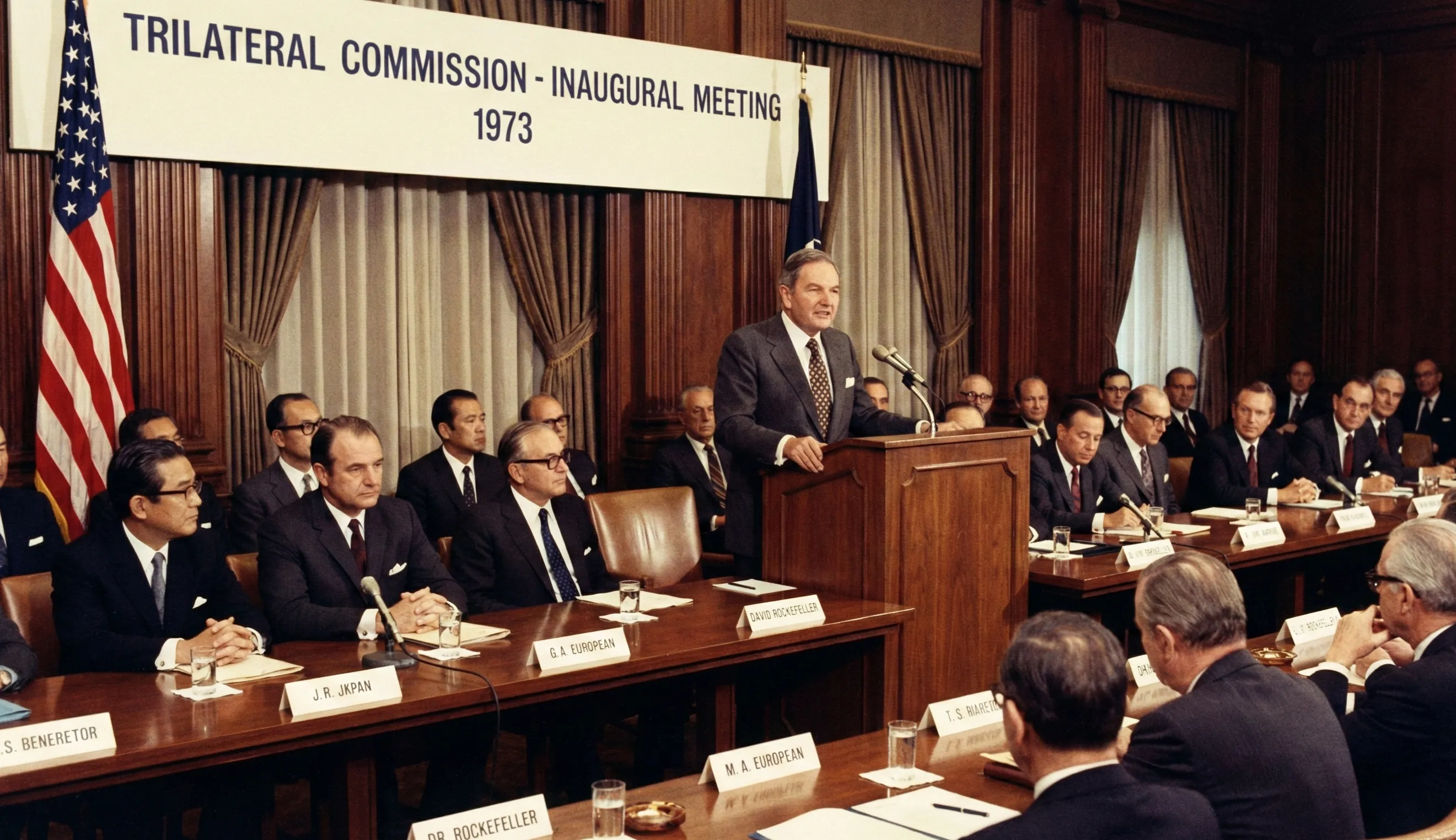
In 1973, David Rockefeller convened a group of influential Americans, Europeans, and Japanese to form a new organization. The Trilateral Commission would promote cooperation among the industrialized democracies at a time of economic turbulence and strategic uncertainty.
Rockefeller was perhaps the most prominent private citizen in the world. As chairman of Chase Manhattan Bank and heir to the Standard Oil fortune, he commanded financial resources and connections that few could match. His initiative carried weight.
> David Rockefeller combined inherited wealth with personal energy to become the premier organizer of elite networks in his era.
The immediate context was crisis. The Bretton Woods monetary system had collapsed in 1971. The oil shock of 1973 disrupted economies worldwide. Trade tensions strained relations among allies. Communist advance in Southeast Asia raised fears of further setbacks.
Zbigniew Brzezinski, then a Columbia University professor, served as the Commission's first director. His book Between Two Ages had proposed new forms of international coordination for the technetronic era. The Commission would attempt to realize this vision.
The trilateral concept reflected geopolitical realities. Western Europe and Japan had recovered from World War II and become economic powers. Yet coordination among these three regions remained informal and inadequate. More systematic engagement seemed necessary.
> The Commission addressed a genuine gap in international organization, whatever one thinks of its methods or agenda.
Membership was by invitation only. Approximately 300 individuals from North America, Western Europe, and Japan would participate. They came from business, politics, academia, and media. The goal was assembling people with influence in their respective spheres.
The organizational model drew on earlier examples. Bilderberg had shown how private gatherings could facilitate elite coordination. The Council on Foreign Relations provided a template for policy oriented discussion. The Commission combined these approaches with a specifically trilateral focus.
Annual meetings brought members together for substantive discussions. Task forces produced reports on specific issues. Publications disseminated ideas to broader audiences. The Commission created an infrastructure for sustained coordination.
> The Commission institutionalized relationships that might otherwise remain ad hoc and episodic.
Jimmy Carter emerged as a prominent early member. The Georgia governor joined in 1973, before he had achieved national prominence. His subsequent rise to the presidency intensified scrutiny of the organization.
When Carter won the presidency in 1976, he appointed numerous Commission members to senior positions. Brzezinski became National Security Advisor. Cyrus Vance became Secretary of State. The Vice President, Treasury Secretary, and many others had Commission connections.
This concentration of Commission members in government provoked controversy. Critics argued that a private organization was effectively staffing the executive branch. Supporters countered that Commission membership simply reflected the pool of qualified candidates.
> The Carter administration demonstrated both the Commission's access to power and the concerns that access generated.
The Commission's early reports addressed pressing issues of the era. Managing interdependence, restructuring international trade, and coordinating macroeconomic policy all received attention. The analyses were generally competent if conventional.
A 1975 report on The Crisis of Democracy proved particularly controversial. It suggested that democratic societies faced governance problems from an excess of democracy. Critics saw this as revealing an anti democratic agenda.
The authors argued they were diagnosing, not prescribing. But the perception persisted that the Commission favored technocratic management over popular participation. This perception aligned with broader critiques of elite coordination.
> Words intended to analyze problems were read as revealing agenda, fairly or not.
The Commission operated openly in most respects. It published membership lists. It released reports publicly. It acknowledged its existence and purposes. This transparency distinguished it from more secretive organizations.
Yet the transparency was selective. Internal discussions remained private. The process of selecting members was opaque. What happened at meetings beyond what appeared in public summaries could only be imagined.
By the early 1980s, the Trilateral Commission had established itself as a significant institution. It had survived the transition from Carter to Reagan despite the latter's initial skepticism. It had created networks that extended across the industrialized world.
> The Commission had become part of the infrastructure of Western elite coordination, whatever individual administrations thought of it.
The original vision had been partially realized. Coordination among the trilateral regions had increased. But whether this owed more to Commission efforts or to broader trends remained unclear. Causation in complex systems is difficult to establish.
Related Articles